


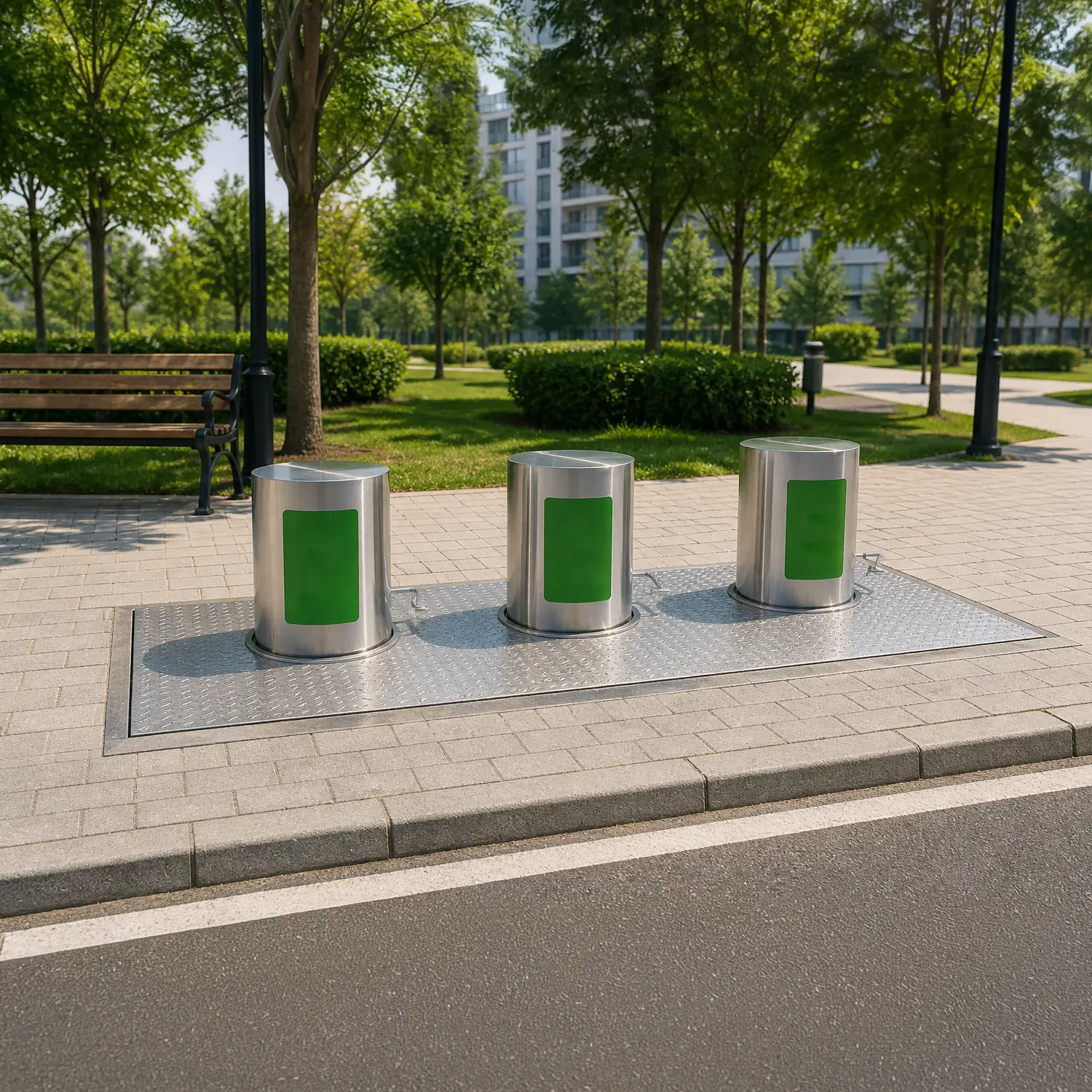


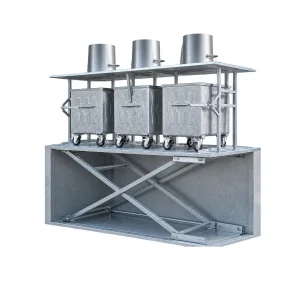
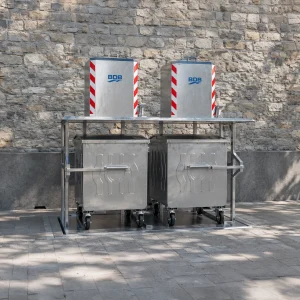
A hydraulic underground bin system stores household waste in standard 1100-litre wheelie bins that sit on a lifting platform inside a sealed concrete pit. At collection time, the platform is raised to street level using hydraulic power from the refuse collection vehicle, and the bins are emptied by the truck’s standard bin lifter. Unlike crane-lifted underground containers, the system does not require a crane-equipped vehicle. BDB Metal manufactures it in 2200-litre (2 × 1100 L) and 3300-litre (3 × 1100 L) configurations at its factories in Ankara, Turkey, and hot-dip galvanises it in its own plant.
Key Features
- 2200 L (2 × 1100 L) and 3300 L (3 × 1100 L) capacities
- Standard 1100 L galvanised bins inside, emptied with the truck’s existing bin lifter
- Lifting power comes from the refuse truck’s hydraulics: no crane-equipped fleet needed
- Body, platform and inner bins hot-dip galvanised to EN ISO 1461 in our own plant
- Powder-coated waste chute in any RAL colour
- Anti-slip walk-on platform; optional remote control
How Does a Hydraulic Underground Bin System Work?
The system works with the rear-loading refuse trucks already in your fleet, so no crane vehicle is needed. To power the lifting platform, the truck needs a female quick-coupling connected to its compactor hydraulic circuit. On most rear-loaders this means a +1 section on the tailgate control valve; trucks without it can be adapted with a minor hydraulic modification. This is a far smaller investment than a crane-equipped fleet. Share your fleet’s truck models when requesting a quote, and we will confirm any modification needed in advance.
Emptying a hydraulic underground bin system takes five steps:
- The refuse collection vehicle pulls up to the collection point.
- A hydraulic hose from the truck is connected to the system’s quick-coupling.
- The hydraulic lift raises the platform, with the 1100 L bins on it, to street level.
- Each 1100 L bin is emptied by the truck’s standard bin lifter and returned to the platform.
- The platform is lowered, the hose is disconnected, and the walk-on surface becomes part of the pavement again.
Why Standard 1100-Litre Bins?
Instead of a single custom-built inner container, the system holds EN 840-compliant 1100-litre galvanised bins. The bins are emptied with the standard lifter fitted to rear-loading refuse trucks, and a damaged bin can be replaced on its own without touching the rest of the system.
Hydraulic vs Crane-Lifted Underground Containers
Both systems store waste below ground. The difference lies in the vehicle used for emptying and in the structure of the inner container. The right choice depends on your fleet and the waste volume at each collection point.
Criterion | Hydraulic Underground Bin System | Crane-Lifted Underground Container |
Collection vehicle | Rear-loading refuse truck with a hydraulic quick-coupling | Crane-equipped collection vehicle |
Lifting system | Hydraulic lifting platform, powered by the truck | Crane with Kinshofer (Double Mushroom), Double Hook or F90 attachment |
Inner container | 2 or 3 standard 1100 L bins | Single-piece underground container body |
Capacity (BDB) | 2200 L / 3300 L | 3500 L / 5000 L |
Best suited to | Councils without crane vehicles, residential developments, campuses | Fleets with crane vehicles, high-volume locations |
Technical Specifications
Specification | 2200 L | 3300 L |
Inner bins | 2 × 1100 L | 3 × 1100 L |
Body finish | Hot-dip galvanised (EN ISO 1461) | Hot-dip galvanised (EN ISO 1461) |
Waste chute (disposal column) | Powder-coated, RAL colours | Powder-coated, RAL colours |
Chute lid mechanism | Spring / gas damper / manual | Spring / gas damper / manual |
Walk-on platform | Anti-slip chequer plate, galvanised | Anti-slip chequer plate, galvanised |
Lifting | Hydraulic, powered by the refuse truck | Hydraulic, powered by the refuse truck |
Options | Remote control, RAL colour | Remote control, RAL colour |
Choosing a Capacity: 2200 L or 3300 L?
Choose the capacity based on the daily waste volume at the collection point and the planned emptying frequency. The 2200 L model suits medium-density neighbourhoods, housing estates, and school or hospital campuses. The 3300 L model is designed for high streets, public squares and densely populated areas, where the extra volume allows fewer collection visits, cutting route time and fuel use.
Materials and Construction
Hot-Dip Galvanised Body and Inner Bins
The body, walk-on platform and 1100 L inner bins are hot-dip galvanised to EN ISO 1461 in our own galvanising plant in Ankara. Below ground, constant moisture and leachate make corrosion progress faster than anywhere else in a waste system. Hot-dip galvanising protects the steel on every surface, including edges and welds, and lasts far longer than painted finishes.
Powder-Coated Waste Chute
The waste chute, the only part visible above ground, is finished with oven-cured electrostatic powder coating that resists scratching, chipping and UV fading. It can be produced in any RAL colour to match the surrounding architecture or a council’s corporate colours. Chute designs can be customised for bulk orders.
Anti-Slip Walk-On Platform
The walk-on platform is made of galvanised chequer plate. When the system is closed, it is part of the pavement and safe to walk on, including in wet weather.
Sealed Concrete Pit
The system sits in a single-piece, watertight concrete pit reinforced with ribbed steel bars, preventing leachate from reaching the soil and groundwater.
Optional Remote Control
An optional remote control module lets the operator raise and lower the platform from outside the vehicle.
Benefits of a Hydraulic Underground Bin System
Kerbside bins attract odours, flies, birds and animals, especially in summer, and overflowing waste spoils the street. In an underground garbage system, waste is kept out of sunlight and sealed off from the outside, so it decomposes more slowly, odours and pests are reduced, and animals cannot reach it. With only the chute above ground, the space can be used as pavement or green space.
Applications
- Municipalities and councils, replacing kerbside bins and bin stores on residential streets and main roads
- Residential developments, housing estates and urban regeneration projects
- School, university and hospital campuses
- Public squares, parks and tourist areas
- High streets and shopping districts
Municipal Tenders and Bulk Orders
We supply municipalities, contractors and facility managers worldwide, with pricing based on quantity and capacity mix. To speed up your quotation, please include the number of units, the capacity (2200 L / 3300 L), the chute colour (RAL), whether you need remote control, and the refuse truck models in your fleet.
Why BDB Metal?
- Manufacturing waste management equipment since 2009
- Three factories and a dedicated hot-dip galvanising plant in Ankara: galvanising is never outsourced
- Exports to more than 40 countries across five continents
- EN 840, EN ISO 1461, EN ISO 3834, ISO 9001, ISO 14001 and ISO 45001 certified
- In-house CNC laser, plasma cutting and press brake production
Frequently Asked Questions
It is a waste collection system in which 1100-litre bins are stored in a concrete pit below ground and raised to street level for emptying by a hydraulic platform powered by the refuse truck. Only the waste chute is visible above ground. It is also known as an underground garbage system, underground trash system or underground refuse system.
It works with rear-loading refuse trucks fitted with a female quick-coupling on the compactor hydraulic circuit, which on most trucks means a +1 section on the tailgate control valve. Trucks without it can be adapted with a minor hydraulic modification. Because the inner bins are standard 1100 L, they are emptied with the truck’s existing bin lifter; no crane vehicle is needed.
A hydraulic system is raised using the refuse truck’s hydraulics and holds standard 1100 L bins. A crane-lifted system needs a crane-equipped vehicle with a Kinshofer, Double Hook or F90 attachment. For fleets without crane vehicles, the hydraulic system is the more practical choice.
No. The hydraulic power for lifting comes from the refuse collection vehicle.
The ground must be suitable, and no electricity, water or gas lines may run through the excavation area. Contact our technical team for pit dimensions and installation requirements.
Yes. BDB Metal exports to more than 40 countries across five continents.


