


Recycling symbols on packaging and bins carry specific information about material type, recyclability and disposal requirements. Most people recognize the familiar triangle made of chasing arrows, yet relatively few understand what the number inside it actually represents. Likewise, symbols such as the Green Dot, WEEE mark and Tidyman are often misunderstood. Understanding these labels is increasingly important for consumers, municipalities and waste management operators alike. This guide explains the most common recycling symbols on packaging and bins, including recycling symbols 1-7, their practical meaning, and what they imply for waste sorting, labeling and procurement decisions.
Recycling Symbols 1–7: Plastic Resin Codes and What They Mean t
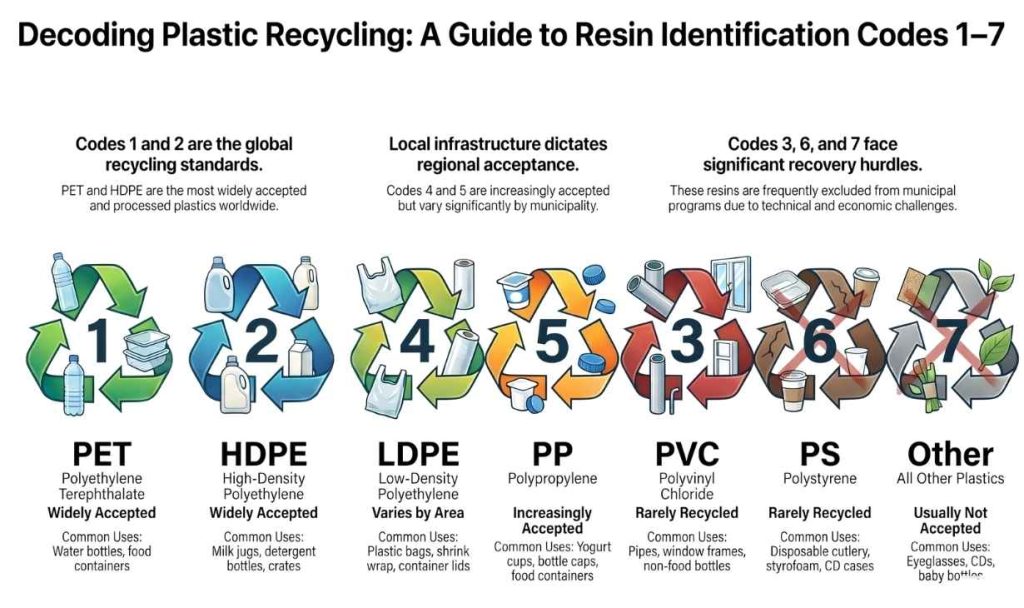
The plastic recycling symbols numbered 1 – 7 were developed by the plastics industry in the 1970s to identify different polymer types. One common misconception is that the number automatically indicates whether an item can be recycled. In reality, the code only identifies the material; actual recyclability depends on local collection and processing infrastructure.
| # | Abbreviation | Plastic Type | Recyclable? | Common Uses |
|---|---|---|---|---|
| 1 | PET | Polyethylene Terephthalate | Yes, widely accepted | Water bottles, food containers |
| 2 | HDPE | High-Density Polyethylene | Yes, widely accepted | Detergent bottles, milk containers |
| 3 | PVC | Polyvinyl Chloride | Rarely | Pipes, window profiles |
| 4 | LDPE | Low-Density Polyethylene | Accepted in some areas | Plastic bags, stretch film |
| 5 | PP | Polypropylene | Increasingly accepted | Yogurt containers, bottle caps |
| 6 | PS | Polystyrene | Rarely | Foam packaging, disposable cups |
| 7 | Other | Mixed plastics and bioplastics | Usually not accepted | Composite materials, bioplastics |
Among the recycling symbols and meanings, codes 1 (PET) and 2 (HDPE) are the most commonly recycled worldwide. Numbers 3, 6 and 7 are often excluded from municipal recycling programs due to technical and economic challenges. It is also important to note that accepted materials may vary significantly between countries, regions and even neighboring municipalities. For waste operators and procurement teams, understanding these codes helps determine appropriate sorting streams and labeling requirements.
The Möbius Loop — The Universal Recycling Symbol
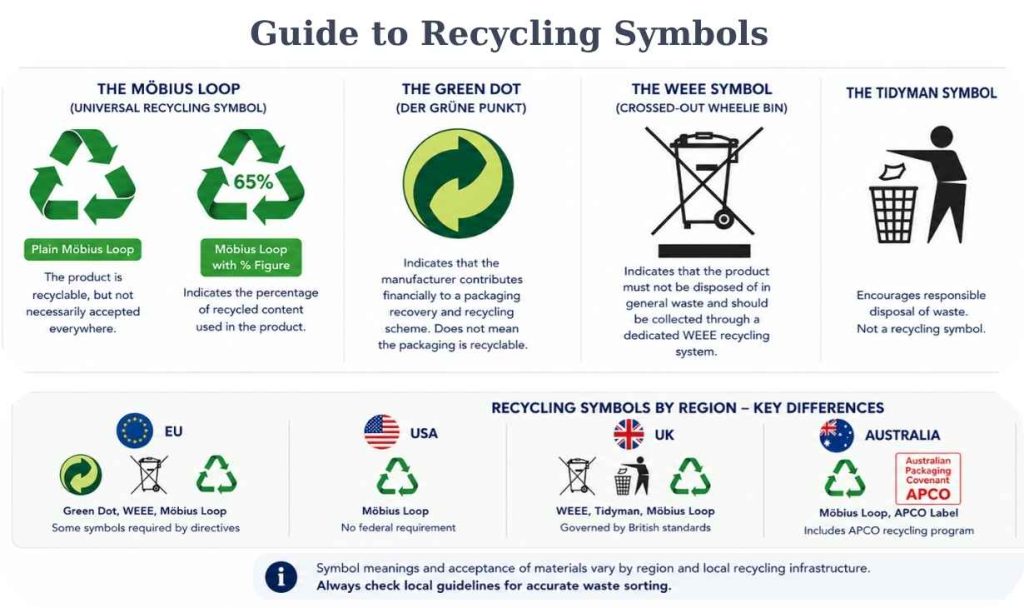
The Möbius Loop, designed by Gary Anderson in 1970, is the most recognizable recycling symbol in the world. It consists of three arrows chasing one another in a continuous loop.
| Version | Meaning |
|---|---|
| Plain Möbius Loop | The product is recyclable, but not necessarily accepted everywhere |
| Möbius Loop with % Figure | Indicates the percentage of recycled content used in the product |
This symbol is often misunderstood. A product displaying the Möbius Loop is not guaranteed to be accepted by every local recycling system. The symbol appears on packaging and is frequently used on recycling symbols on bins as part of public waste separation systems. When combined with clear color coding, it becomes much easier for users to sort waste correctly. Learn more in our guide to trash can color meanings.
The Green Dot — What It Does Not Mean
The Green Dot (Der Grüne Punkt) originated in Germany in 1991 and is now used across more than 30 countries. It is one of the most frequently misunderstood packaging symbols.
The symbol does not indicate that a product is recyclable. Instead, it shows that the manufacturer contributes financially to a packaging recovery and recycling scheme. The Green Dot is commonly used in Germany, France, Spain, Belgium and many other EU countries. While it has little direct impact on bin purchasing decisions, manufacturers exporting packaging into European markets should understand its significance.
The WEEE Symbol — The Crossed-Out Wheelie Bin
The crossed-out wheelie bin symbol identifies electrical and electronic equipment covered by the EU WEEE Directive (2012/19/EU). Products displaying this mark must not be disposed of with general household waste.
| Common WEEE Products |
|---|
| Batteries |
| Electronics |
| Household appliances |
| Lighting equipment |
For municipalities and waste operators, the WEEE symbol has practical implications. Separate collection infrastructure is often required for these waste streams. Many municipal recycling centers use dedicated collection points and specialized municipal recycling bins for WEEE materials. Municipalities planning dedicated WEEE collection infrastructure can explore a wide range of recycling stations and waste separation solutions in BDB Metal’s recycling product range.
The Tidyman Symbol
The Tidyman symbol depicts a person placing litter into a bin. Developed in the United Kingdom in 1969, it is a globally recognized anti-littering symbol.
Unlike many people assume, it is not a recycling symbol. Its purpose is simply to encourage responsible disposal of waste. The Tidyman is widely used on packaging, public signage and recycling bins for public spaces to promote cleaner environments.
FSC and PEFC — Sustainable Paper and Wood Symbols
FSC (Forest Stewardship Council) and PEFC (Programme for the Endorsement of Forest Certification) symbols are commonly found on cardboard packaging, paper products and wooden goods.
| Symbol | Meaning |
|---|---|
| FSC | Certified sustainable forest management |
| PEFC | Alternative sustainable forest certification system |
These certifications do not indicate recyclability. Instead, they demonstrate that raw materials originate from responsibly managed forests. For procurement professionals and organizations with sustainability targets, these labels play an important role in supplier selection and environmental reporting.
Recycling Symbols by Region — Key Differences
The meaning and prevalence of recycling symbols can vary by region.
| Region | Common Symbols | Notes |
|---|---|---|
| EU | Green Dot, WEEE, Möbius Loop, Resin Codes | Some symbols required by directives |
| USA | Möbius Loop, Resin Codes 1–7 | No federal requirement |
| UK | WEEE, Tidyman, Möbius Loop | Governed by British standards |
| Australia | Möbius Loop, Resin Codes, APCO Label | Includes APCO recycling program |
| Global Export Markets | EU-oriented symbols | EU compliance often influences labeling |
Understanding these regional differences is particularly important for exporters, municipalities and manufacturers supplying international markets.
What These Symbols Mean for Bin Labeling and Procurement
For municipalities and waste management operators, understanding recycling symbols and meanings goes beyond packaging compliance. The correct symbol helps determine which waste stream requires a dedicated collection bin, while effective labeling improves sorting accuracy and reduces contamination.
On the bins themselves, symbols are often combined with color coding to guide users toward correct disposal. For example, a blue bin marked with the Möbius Loop signals recyclables, while a brown bin with an organics label indicates food waste.
The most successful waste separation systems combine recognized symbols with consistent color coding. To better understand how colors are used to identify different waste streams, read our trash can color meaning guide.
BDB Metal manufactures customized recycling solutions for municipalities, public spaces and commercial facilities. Custom labeling, symbol applications, color coding, compartment configurations and branding options can all be tailored to project requirements. Whether you require bulk supply for a city-wide recycling initiative or export-ready waste collection systems, BDB Metal offers flexible manufacturing and logistics support. Explore BDB Metal’s recycling bins and waste collection solutions to find systems designed for a wide range of recycling and waste separation applications.
Request a project-specific quotation: www.bdbmetal.com/en/get-a-project-offer/
FAQ — Recycling Symbols
They identify the type of plastic resin used in a product. They do not automatically indicate whether the item is recyclable in your local area.
No. The symbol generally indicates that a product is recyclable, but actual recycling depends on local collection and processing capabilities.
It indicates that the manufacturer contributes financially to a packaging recovery system. It does not mean the packaging is recyclable.
It indicates that the product must not be disposed of in general waste and should be collected through a dedicated WEEE recycling system.
No. While some symbols are globally recognized, regulations, interpretations and acceptance criteria vary between regions.
PET (#1) and HDPE (#2) are the most widely accepted. Acceptance of other resin codes depends on local recycling infrastructure.

Other News
Recycling Bins for Hospitals: A Bulk Buying Guide
Hospital recycling bins should match the materials collected in each...
Sep
Wholesale Galvanized Waste Containers for Municipalities: The Complete EN 840 & EN 1461 Buyer’s Guide
Buying wholesale galvanized waste containers for a municipality requires more...
Sep
DIN 30720 Skip & Hooklift Containers: Dimensions, Hook Heights and Compliance Checklist
When you are purchasing containers for construction rubble, demolition waste,...
Sep
Crane-Lifted Waste Containers Explained
When you purchase an aboveground or underground waste container, capacity...
Sep
Recycling Bins for Shopping Malls: Selection and Placement
Recycling bins for shopping malls should match the waste generated...
Sep
Shopping Mall Waste Management: Collection and Storage
Shopping mall waste management needs a continuous route from shops,...
Sep
Recycling Bins for Hotels: A Practical Buying Guide
Recycling bins for hotels need to work for both guests...
Sep
Hotel Waste Management: A Practical Planning Guide
Hotel waste management connects waste prevention, separation, internal collection and...
Sep
Recycling Symbols 1–7 Explained: What They Mean on Packaging and Bins
Recycling symbols on packaging and bins carry specific information about...
Jun