


Garbage truck dimensions directly determine operational efficiency, fuel consumption, and route optimization in modern waste management systems. If you are planning a municipal investment or sourcing for export projects, contact BDB Metal today for bulk pricing and chassis-compatible solutions tailored to your fleet.
Selecting the correct body size is not only about volume; it is about matching garbage truck capacity with operational density, road conditions, and bin infrastructure. Proper planning ensures long-term savings and mechanical reliability.
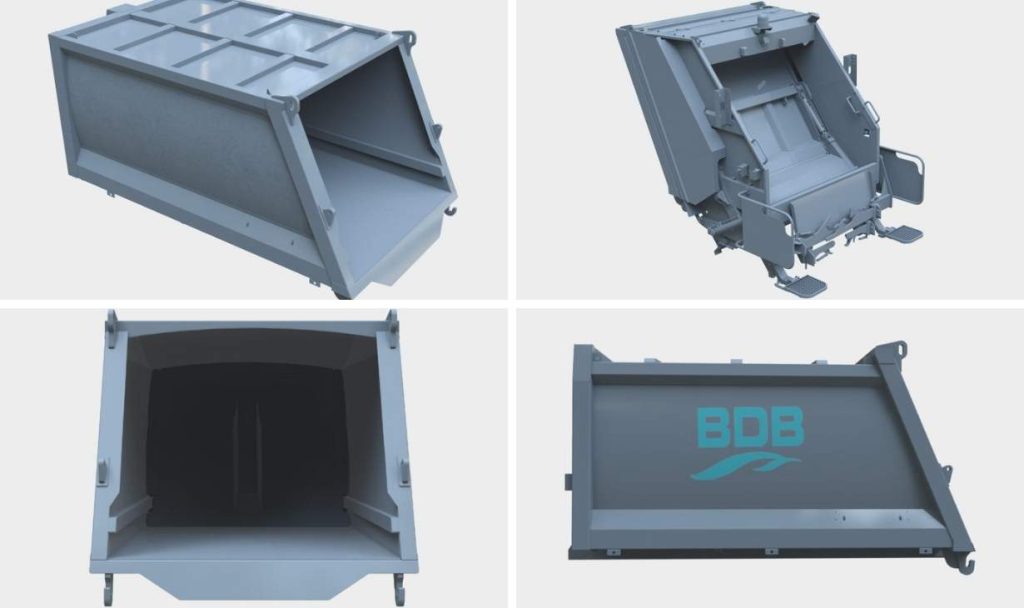
Understanding Garbage Truck Volumes: From 8m³ to 22m³
At BDB Metal, we manufacture bodies ranging from 8m³ to 22m³, addressing both small-scale municipalities and heavy-duty metropolitan operations.
- 8 m³ bodies are ideal for small towns and light-duty chassis. They are commonly mounted on vehicles such as Isuzu NPR 10 and are suitable for low-density residential areas.
- 9 m³ bodies serve mid-scale collection routes and medium-duty operations.
- 16 m³ bodies are widely used in industrial zones and high-density districts, offering optimal balance between maneuverability and waste truck volume.
- 22 m³ bodies are designed for metropolitan municipalities and heavy industrial regions requiring maximum garbage truck capacity.
Different superstructure types (compactor, side loader, front loader, hooklift, or recycling bodies) further influence operational performance depending on application needs.
Technical Specifications: Dimensions and Vehicle Matching
Correct standard garbage truck sizes must align with chassis load limits and hydraulic system compatibility. For example, 16m³ compactor bodies are typically mounted on medium-duty chassis such as Mercedes Atego 1518 or Ford Trucks 1833 DC models. This configuration ensures proper axle load distribution and stability during full compaction cycles.
BDB Metal hydraulic systems operate at 180±10 bar pressure, a critical specification for consistent compaction performance. PTO speed ranges between 750–1500 RPM, ensuring synchronized operation between engine and hydraulic compactor.
Our bodies are fully compatible with 120L, 240L, 400L, 770L, and 1100L bins. This high level of container compatibility ensures seamless integration into existing municipal bin infrastructure without requiring fleet redesign.
The Lifter Standard: Why EN Compliance Matters
All BDB Metal lifting mechanisms are manufactured in accordance with EN 1501 standards, which regulate vehicle-mounted waste collection equipment in Europe. This ensures operational safety, structural reliability, and full compliance with internationally recognized performance requirements.
In addition, our lifting systems are fully compatible with containers manufactured under EN 840 standards. This means BDB Metal garbage truck bodies can safely lift and empty all EN 840-compliant bins and metal garbage containers without modification.
For international tenders and EU-aligned infrastructure projects, EN compliance is critical. It guarantees seamless integration with standardized container geometries and comb-lift systems, providing municipalities and contractors with long-term operational compatibility and procurement security.
Maximizing ROI: Choosing the Right Container for High-Compaction Bodies
This is the conversion zone of waste logistics planning. BDB compactor systems offer a 5:1 to 6:1 compaction ratio for household waste. Such compression significantly increases effective garbage truck capacity, reducing collection frequency and fuel consumption.
However, high compaction ratios require durable containers capable of withstanding repeated mechanical stress. Thin or low-grade bins may deform under heavy compression cycles, increasing replacement costs.
Selecting compatible and reinforced bins alongside correctly calculated Garbage truck dimensions protects hydraulic components, minimizes downtime, and extends equipment lifespan.
Proper dimension planning also reduces unnecessary route duplication, optimizes fuel consumption, and lowers maintenance costs caused by overloading.
As one of the leading garbage truck body manufacturers, BDB Metal designs export-ready bodies engineered for performance, durability, and full integration with modern waste management systems.
In summary, aligning body volume, chassis capacity, hydraulic performance, and bin strength is the foundation of efficient waste logistics. When Garbage truck dimensions are strategically selected, municipalities and contractors benefit from lower operational costs, longer service life, and higher fleet productivity.

Other News
Recycling Bins for Hospitals: A Bulk Buying Guide
Hospital recycling bins should match the materials collected in each...
Sep
Wholesale Galvanized Waste Containers for Municipalities: The Complete EN 840 & EN 1461 Buyer’s Guide
Buying wholesale galvanized waste containers for a municipality requires more...
Sep
DIN 30720 Skip & Hooklift Containers: Dimensions, Hook Heights and Compliance Checklist
When you are purchasing containers for construction rubble, demolition waste,...
Sep
Crane-Lifted Waste Containers Explained
When you purchase an aboveground or underground waste container, capacity...
Sep
Recycling Bins for Shopping Malls: Selection and Placement
Recycling bins for shopping malls should match the waste generated...
Sep
Shopping Mall Waste Management: Collection and Storage
Shopping mall waste management needs a continuous route from shops,...
Sep
Recycling Bins for Hotels: A Practical Buying Guide
Recycling bins for hotels need to work for both guests...
Sep
Hotel Waste Management: A Practical Planning Guide
Hotel waste management connects waste prevention, separation, internal collection and...
Sep
Recycling Symbols 1–7 Explained: What They Mean on Packaging and Bins
Recycling symbols on packaging and bins carry specific information about...
Jun