


Hotel waste management connects waste prevention, separation, internal collection and storage into one working system. For hotel operators, the challenge is keeping that system consistent from a guest’s room to the containers awaiting collection outside.
A lobby recycling station cannot solve overflowing kitchen containers. Equally, mixing separately collected materials during housekeeping can undermine separation efforts and make recovery more difficult.
Key takeaways
- Hotel waste management works only as a coordinated system — equipment, staff responsibilities and collection schedules all supporting the same flow, not simply more bins.
- Separation must survive the whole journey: from the guest room, through housekeeping and internal transfer, to the central waste area.
- Reducing food waste and packaging at source lowers both disposal cost and the container capacity you need to buy.
- Container selection follows the operation: measure accumulation per stream first, then choose material, capacity and lifting interface.
- Measuring results by stream — against occupied rooms, meals served and events — is what turns a one-off clean-up into a lasting improvement.
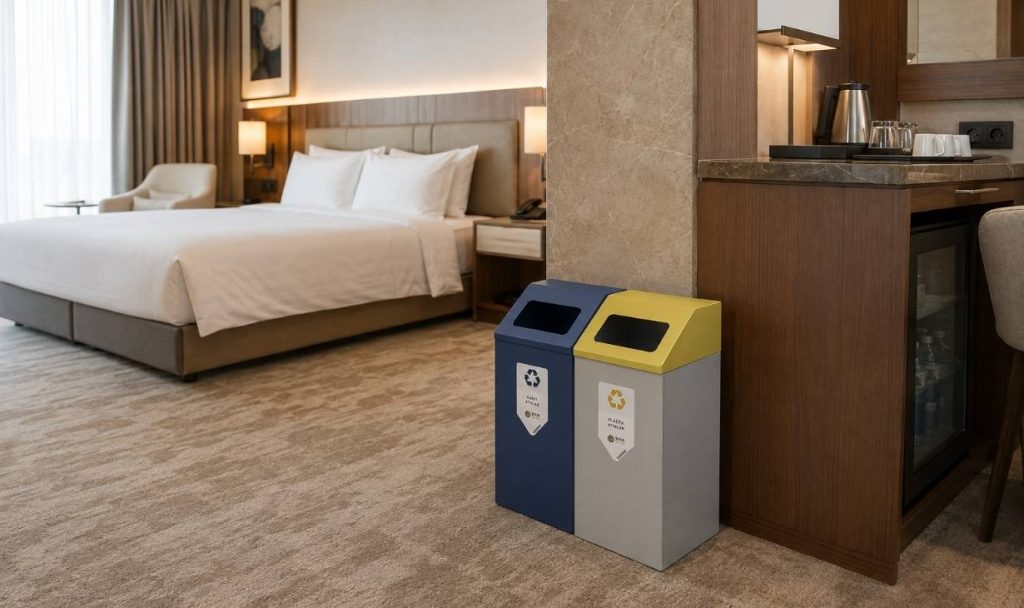
Table of Content
How to Build a Hotel Waste Management Plan
Start by recording what each department discards, where it happens and how quantities change. Include guest rooms, kitchens, restaurants, meeting spaces, receiving areas and outdoor facilities.
Observe ordinary days and busy periods. Room occupancy alone will not explain waste from a wedding, conference or restaurant serving non-resident guests.
A practical hotel waste management plan should identify:
- Accepted materials and separate collection requirements.
- Collection points and the team responsible for each.
- Emptying and cleaning routines, including shift handovers.
- Internal routes and external pickup arrangements.
- The response to overflow, contamination or missed collections.
Translate the policy into everyday tasks. This illustrative table provides a starting point, not a fixed collection schedule:
| Area | Waste stream | Responsible team | Collection trigger |
| Guest rooms | Accepted recyclables and residual waste | Housekeeping | Room servicing and additional checks where needed |
| Kitchens | Food waste and packaging, collected separately | Kitchen team | Service intervals or agreed safe fill limits |
| Receiving area | Cardboard and transport packaging | Stores team | After deliveries |
| Meeting spaces | Bottles, cans and residual waste | Events and cleaning teams | Between sessions and after events |
| Central waste area | Each separately collected stream | Facilities team | Fill-level checks and contractor schedule |
Assign a backup for each task. Waste management in the hospitality industry involves several departments, so clear handovers are essential. Effective waste management for hotels should remain consistent when shifts change or occupancy increases.
Reduce Food Waste and Unnecessary Packaging
Food waste management in hotels begins before leftovers reach a container. Record preparation waste, spoiled stock and plate waste separately to distinguish purchasing problems from overproduction or unsuitable portions. Food waste can represent a significant operational cost, including purchased ingredients, preparation and disposal. Measuring it helps identify avoidable losses and determine whether collection frequency or storage capacity needs to change.
Adjust preparation to expected diners, replenish buffets in smaller batches and review dishes repeatedly returned uneaten. Check purchasing quantities against actual consumption, particularly around seasonal changes and large events.
Where a food-waste collection service is available, confirm accepted materials and liner requirements. Do not assume packaging labelled “compostable” can enter that service.
Packaging needs a similar review. Discuss reusable delivery crates, reduced outer packaging and suitable refill systems with suppliers. Keep cardboard dry and separate from wet waste, and flatten boxes where this suits the collection arrangement.
Waste management in hotels and restaurants should combine prevention with collection: separating an unnecessary item does not remove the opportunity to avoid it in the first place.
Keep Waste Separated During Housekeeping and Collection
Hotel waste recycling depends on what happens after the guest uses the bin. Housekeeping needs enough separate collection capacity to preserve the separation indicated by the labels.
Match room-bin instructions to the bags, service containers and central collection points used by staff. Identify streams with material names and recognisable illustrations rather than colour alone.
The procedure should explain:
- Which materials belong in each stream.
- How bags or compartments remain separate during transfer.
- Where each stream goes in the central waste area.
- How staff report contamination or unexpected waste.
Plan designated holding points so collected bags do not accumulate in guest corridors. Assess service routes for door clearances, lift dimensions, thresholds and manoeuvring space.
Internal hotel waste collection and external pickup are different schedules. Housekeeping or kitchen rounds may need adjustment after breakfast and events even when the contractor’s timetable remains unchanged.
For guest-facing equipment, see our recycling bins for hotels buying guide.
Match Containers to Storage Space and Collection Frequency
Choose service and central-storage equipment according to its role. The following table covers the operational equipment beyond guest-facing recycling stations:
| Hotel area | Operational requirement | Equipment to consider | Key selection check |
| Kitchens and preparation areas | Frequent emptying and separate handling of food waste and packaging | Suitable pedal bins or lidded wheeled plastic containers | Cleaning access, lid operation and safe loaded weight |
| Floor service rooms | Temporary holding without mixing streams | Clearly labelled, lidded wheeled service containers | Available space, cleaning access and ease of transfer |
| Internal transfer routes | Moving waste to central storage | Appropriately sized wheeled containers | Doors, lifts, ramps, wheel suitability and manoeuvrability |
| Central waste areas | Storage until external collection | Plastic or galvanised metal containers | Required volume, handling conditions and vehicle compatibility |
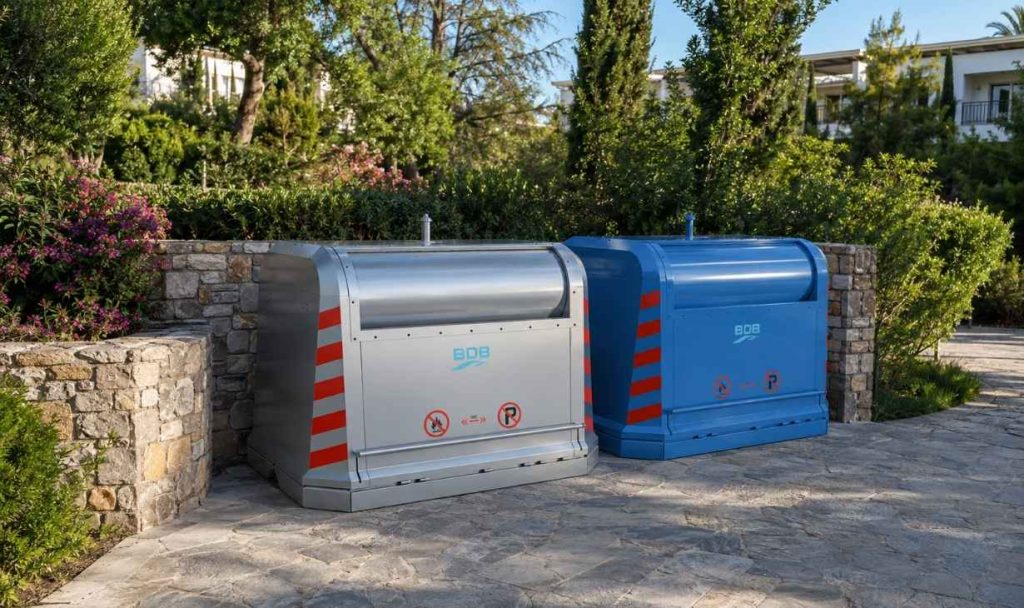
| Large resorts and holiday complexes | Higher-capacity central collection | Above-ground or underground systems | Site access, lifting arrangements and infrastructure |
Plastic containers can suit service areas where equipment needs frequent moving and washing. Galvanised metal containers can be considered for central areas exposed to intensive handling and impacts. Neither material should be selected without checking the actual load, environment and maintenance requirements.
For underground systems, assess excavation, drainage, underground services and maintenance access before committing to the layout.
Calculate accumulation before selecting nominal capacity
Measure each stream separately. As an illustrative calculation, 300 litres of dry recycling per day over a two-day collection interval produces 600 litres of accumulated material.
That is the starting volume not the final nominal container capacity. Allow for observed variation, usable fill limits and collection delays. Do not apply the same storage interval automatically to food waste.
Hotel solid waste management also requires a weight check: a container holding glass may reach its permitted load before its available volume is used.
Before ordering, verify lid-opening clearance, cleaning access, safe handling and the collection vehicle’s lifting interface. Plan central storage with attention to odours, leakage, pests and separation from guest routes and food-handling areas.
Review BDB Metal’s waste container range against these requirements. Confirm hotel waste disposal and recovery arrangements with the collection provider before finalising specifications.
Measure Results and Improve Daily Procedures
Track waste quantities by stream, contamination reports, overflows and missed collections. Review results alongside occupied room nights, meals served and event activity. Lower total waste during a quiet month does not necessarily mean better performance.
For hotel food waste management, comparing preparation waste, spoilage and plate waste over time helps identify which changes are working. Reducing and managing food waste in hotels requires this feedback, not just separate containers.
The World Sustainable Hospitality Alliance’s Hotel Waste Measurement Methodology provides a common framework for collecting and reporting hotel waste data.
Effective hospitality waste management also uses staff observations. Repeated contamination at one station may indicate unclear labels or poor positioning; repeated overflow may indicate a collection-timing problem rather than insufficient total capacity.
Review procedures after menu changes, renovations and new event operations. Waste management in hotels should evolve with the property.
Prepare Your Equipment Requirements
Turn the operating plan into a purchasing brief containing:
- An area-by-area equipment list and quantities.
- Waste streams, measured volumes and collection intervals.
- Capacity, material, finish and lid requirements.
- Door, lift and storage-area dimensions.
- Wheel, load and vehicle-lifting requirements where applicable.
- Labels, languages, colours and identification.
- Sample approval, delivery and replacement-part requirements.
Keep stationary recycling units distinct from wheeled containers used for internal transport. Standardise identification across the property without forcing every department to use the same equipment.
Manufacturing and Project Supply by BDB Metal
BDB Metal operates four factories in Ankara, Türkiye, and exports to more than 40 countries. With cutting, bending, welding, painting and galvanising carried out in-house, the company has a monthly production capacity of 12,000 metal waste containers.
For hotel groups and project buyers, BDB Metal offers recycling units, plastic service containers, galvanised metal containers and above-ground or underground systems. Project-specific dimensions, RAL colours, logos and pictograms can be discussed according to the equipment selected.
Share your equipment schedule, site dimensions, collection requirements and delivery destination to discuss a coordinated supply package for your property.

Other News
Recycling Bins for Hospitals: A Bulk Buying Guide
Hospital recycling bins should match the materials collected in each...
Sep
Wholesale Galvanized Waste Containers for Municipalities: The Complete EN 840 & EN 1461 Buyer’s Guide
Buying wholesale galvanized waste containers for a municipality requires more...
Sep
DIN 30720 Skip & Hooklift Containers: Dimensions, Hook Heights and Compliance Checklist
When you are purchasing containers for construction rubble, demolition waste,...
Sep
Crane-Lifted Waste Containers Explained
When you purchase an aboveground or underground waste container, capacity...
Sep
Recycling Bins for Shopping Malls: Selection and Placement
Recycling bins for shopping malls should match the waste generated...
Sep
Shopping Mall Waste Management: Collection and Storage
Shopping mall waste management needs a continuous route from shops,...
Sep
Recycling Bins for Hotels: A Practical Buying Guide
Recycling bins for hotels need to work for both guests...
Sep
Hotel Waste Management: A Practical Planning Guide
Hotel waste management connects waste prevention, separation, internal collection and...
Sep
Recycling Symbols 1–7 Explained: What They Mean on Packaging and Bins
Recycling symbols on packaging and bins carry specific information about...
Jun