


Buying wholesale galvanized waste containers for a municipality requires more than comparing capacity and unit price. Procurement teams also need to evaluate EN 840 compatibility, galvanizing quality, steel thickness, lifting systems, corrosion protection, container loading efficiency, customization and long-term operating cost.
At BDB Metal, we manufacture metal waste-container solutions in Turkey for municipal, commercial and industrial projects. Our product range includes different capacities and configurations designed for bulk orders and international supply.
This guide explains what municipalities, distributors, waste-management companies and importers should check before purchasing galvanized waste containers from Turkey, especially when the project specification refers to EN 840 and EN ISO 1461.
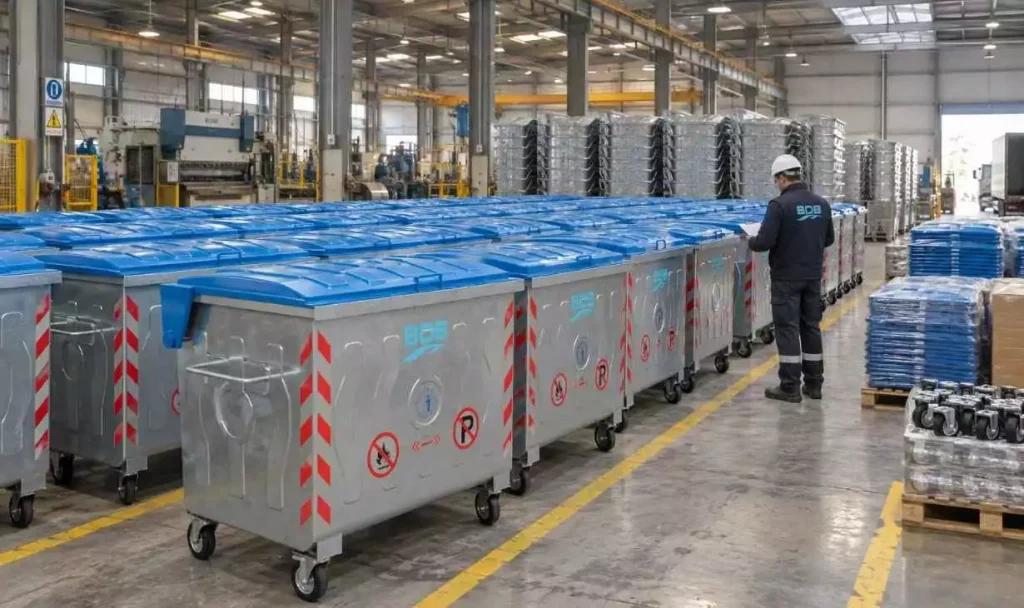
Table Of Content
What Is a Galvanized Municipal Waste Container?
A galvanized municipal waste container is a steel waste-collection container protected against corrosion by a zinc coating. Depending on the model, it may use two or four wheels and may include different lid, lifting and handling systems.
Municipal containers are exposed to outdoor weather, repeated lifting cycles, impact, heavy waste loads and frequent movement. For this reason, buyers should evaluate the entire construction of the container rather than focusing only on capacity.
Steel thickness, galvanizing quality, welds, wheels, lids, reinforcements and lifting interfaces all influence long-term performance.
For more detail on durability criteria, see our guide to choosing the longest-lasting metal waste containers.
What Is the Difference Between EN 840 and EN ISO 1461?
EN 840 and EN ISO 1461 address different aspects of a galvanized municipal waste container.
| Standard | What It Covers | Why It Matters |
| EN 840 | Dimensions, design, lifting interfaces and related requirements for mobile waste containers | Helps ensure compatibility with standardized collection and lifting systems |
| EN ISO 1461 | Hot-dip galvanized coatings on fabricated iron and steel articles | Defines requirements for zinc coating quality and corrosion protection |
| Both together | Container functionality plus galvanized coating performance | Provides a more complete technical specification |
EN 840 is mainly concerned with how mobile waste containers are designed and handled within collection systems. Different parts of the standard apply to different container configurations.
EN ISO 1461, on the other hand, defines requirements and test methods for hot-dip galvanized coatings applied to fabricated steel and iron products.
For buyers, this distinction is important. Writing only “galvanized waste container” in an RFQ does not provide enough technical detail. If hot-dip galvanizing according to EN ISO 1461 is required, it should be stated explicitly.
Which Container Capacities Are Common for Municipal Projects?
The right capacity depends on waste volume, collection frequency, installation area and vehicle compatibility.
BDB Metal manufactures different metal waste-container sizes for municipal and commercial applications. Common capacities include smaller two-wheel models and larger four-wheel containers used in high-volume collection areas.
| Capacity | Typical Use |
| 120 L | Low-volume public and institutional areas |
| 240 L | Small municipal and commercial collection points |
| 400 L | Medium-volume waste collection |
| 770 L | Streets, commercial zones and public facilities |
| 1,100 L | High-volume municipal and commercial collection |
For broader public-space waste-management planning, buyers can also review our recycling bins for municipalities guide. This is one of the relevant English municipal resources listed in BDB Metal’s current content inventory.
How Does Steel Thickness Affect Container Life?
Steel thickness affects structural strength, resistance to impact and the container’s ability to retain its shape during intensive use.
BDB Metal offers different sheet-thickness options for metal waste containers, with several models providing specifications between approximately 1.2 mm and 2.0 mm, depending on the project and container type.
| Steel Thickness | General Characteristics | Typical Procurement Consideration |
| 1.2 mm | Lighter construction | Useful when weight and initial cost are important |
| 1.5 mm | Balanced construction | Suitable for many general municipal applications |
| 2.0 mm | Higher structural reserve | Preferred for intensive use and higher mechanical exposure |
A thicker steel sheet does not automatically guarantee a specific number of service years. Container life also depends on galvanizing quality, weld construction, waste type, collection frequency, loading impact, environmental exposure and maintenance.
A better purchasing approach is to evaluate steel thickness, corrosion protection and structural design together.
Hot-Dip Galvanizing Thickness: What Should Buyers Check?
Galvanizing is one of the most important factors affecting the corrosion resistance of a steel waste container.
EN ISO 1461 defines minimum local and mean coating thickness values according to the thickness of the fabricated steel article.
| Steel Article Thickness | Minimum Local Coating | Minimum Mean Coating |
| Below 1.5 mm | 35 µm | 45 µm |
| 1.5 mm to 3 mm | 45 µm | 55 µm |
| Over 3 mm to 6 mm | 55 µm | 70 µm |
| Over 6 mm | 70 µm | 85 µm |
These figures are useful because they give procurement teams measurable criteria.
For example, a buyer should not compare two products only by asking whether both are “galvanized.” Instead, the RFQ should specify the required galvanizing process and applicable standard.
It is also important to separate steel thickness from zinc coating thickness. Steel thickness mainly affects structural strength. Zinc coating thickness mainly affects corrosion protection. A technically stronger procurement specification defines both.
What Affects the Unit Cost of a Galvanized Waste Container?
Wholesale pricing depends on more than container capacity. Two quotations for a 1,100 L galvanized waste container may differ significantly because the manufacturers are offering different steel thicknesses, lids, wheels, galvanizing systems or lifting interfaces.
| Cost Factor | Effect on Unit Cost |
| Steel thickness | More material generally increases cost |
| Capacity | Larger containers require more steel and larger components |
| Galvanizing | Surface-treatment method affects production cost |
| Lid system | Plastic, metal, flat, dome or pedal systems change component cost |
| Wheels and brakes | Heavy-duty wheels and braking systems increase specification level |
| Lifting interface | Vehicle-compatible lifting systems may require different construction |
| Reinforcement | Additional forming and reinforcement increase material and manufacturing requirements |
| Branding | Logos, labels and special colors add customization |
| Order quantity | Larger runs may improve manufacturing efficiency |
| Packing density | Efficient nesting can reduce freight per unit |
| Incoterm | EXW, FCA, FOB and CIF quotations should not be compared as if they were identical |
For international purchasing, it is therefore better to compare landed cost rather than factory unit price alone.
A practical calculation is: Total container cost = purchase price + freight + maintenance + spare parts + expected replacement cost
This approach gives municipalities and distributors a clearer picture of long-term value.
What Is the MOQ for Wholesale Galvanized Waste Containers?
There is no single MOQ that applies to every municipal container project. Minimum order quantity may depend on container size, sheet thickness, galvanizing method, lid type, color, logo, lifting interface and destination. For bulk procurement, buyers should request quantity-based pricing rather than asking only for one unit price.
A useful RFQ can include pricing at several volumes, such as 100, 250, 500 or 1,000 units, when these quantities are relevant to the project. Buyers should also confirm whether different capacities can be combined in the same order and whether customization has a separate MOQ.
For further information on bulk purchasing considerations, see our bulk container procurement guide.
How Many Waste Containers Fit in a 40-Foot Container?
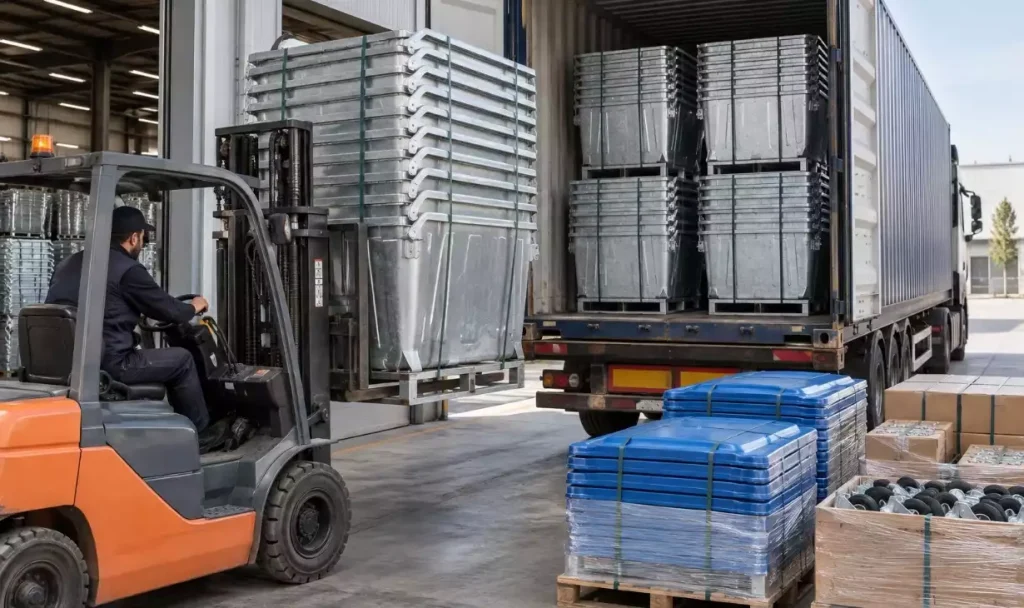
Freight efficiency can materially change the real import cost of municipal waste containers. The number of units that can be loaded into a 40-foot or 40-foot High Cube container depends on:
container dimensions, nesting design, whether wheels and lids are assembled, packaging requirements and the exact shipping configuration.
For selected BDB Metal metal-container models, published loading configurations provide useful reference points.
| Model | Published Loading Reference |
| 240 L galvanized metal container | Up to approximately 236 units |
| 1,100 L galvanized metal container | Up to approximately 94 units |
| Other sizes | Must be confirmed according to configuration |
These figures should be treated as model- and configuration-dependent loading references, not universal guarantees for every shipment. Before comparing freight costs, buyers should request a packing plan showing: units per container, gross weight, CBM, package format and assembly status.
Loading density is particularly important because freight cost per unit decreases when more containers can be transported in the same shipment.
If one shipment costs USD 5,000 and contains 50 units, freight is USD 100 per container. If the same freight cost covers 90 units, freight falls to about USD 55.56 per container.
The example shows why the cheapest EXW quotation is not always the cheapest landed solution.
What Is a Realistic Delivery Lead Time?
Municipal buyers often need predictable production and shipment schedules, especially for tenders or phased public projects.
Lead time depends on several stages:
| Stage | Main Variables |
| Technical approval | Final drawings and specification confirmation |
| Raw material | Steel and component availability |
| Manufacturing | Quantity, model and factory production schedule |
| Galvanizing | Batch and surface-treatment scheduling |
| Quality control | Inspection and project documentation |
| Packing | Export packing and loading configuration |
| Dispatch | Truck, vessel, customs and destination planning |
BDB Metal’s municipal procurement content states production capacity of up to 12,000 waste containers per month across different sizes. However, manufacturing capacity is not the same as a guaranteed project lead time. An actual quotation should therefore specify the agreed production period, ready-to-ship date and estimated dispatch schedule.
For buyers, a written delivery commitment is more useful than relying only on a factory’s theoretical monthly capacity.
What Should Be Included in a Municipal RFQ?
A good RFQ allows different manufacturers to quote the same product specification. Without a detailed technical specification, comparing quotations becomes difficult because each supplier may be offering a different product.
| RFQ Requirement | Information to Specify |
| Capacity | 120 L, 240 L, 400 L, 770 L, 1,100 L or another size |
| Quantity | Total required units |
| Standard | Applicable EN 840 requirement |
| Steel | Required sheet thickness |
| Galvanizing | EN ISO 1461 if hot-dip galvanizing is required |
| Lid | Metal, plastic, flat, dome or other system |
| Wheels | Wheel size, brakes and material |
| Lifting | Compatibility with the existing garbage-truck fleet |
| Color | Galvanized finish or RAL color |
| Branding | Municipality logo and labels |
| Spare parts | Wheels, lids, hinges and hardware |
| Shipping | Destination and required Incoterm |
| Loading | Units per 40′ or 40′ HC container |
| Delivery | Production and dispatch lead time |
The more clearly these parameters are defined, the easier it becomes to compare manufacturers on equal terms.
Why Does EN 840 Compatibility Matter for Garbage Trucks?
A waste container is part of a wider waste-collection system. The container must work correctly with the municipality’s lifting equipment, collection vehicles and operating procedures. This is why EN 840 compatibility is important when purchasing large quantities of municipal containers.
For example, a container may have the correct nominal capacity but still be unsuitable if its lifting interface does not match the existing garbage-truck fleet. Before ordering, buyers should confirm container dimensions, lifting points and collection-system compatibility.
Our garbage truck dimensions and container compatibility guide provides additional information on this subject. The page is also included among BDB Metal’s English technical resources.
Why Import Galvanized Waste Containers from Turkey?
Turkey is a practical sourcing location for European municipalities, distributors and waste-management companies because it combines industrial metalworking capacity with road and sea export access. However, supplier selection should not be based on country or price alone.
The better question is: Which manufacturer can provide the required EN 840 configuration, steel specification, galvanizing quality, production quantity and shipping efficiency at a competitive landed cost?
BDB Metal manufactures metal waste containers in Turkey for municipal, commercial and international projects. For buyers, this means container specifications can be evaluated according to the project: capacity, sheet thickness, galvanizing, lifting system, color, branding, quantity and destination.
What Should European Buyers Verify Before Ordering?
European buyers should verify the exact project and tender requirements before placing a bulk order. Particular attention should be given to the applicable EN 840 configuration and whether the project requires hot-dip galvanizing according to EN ISO 1461.
Model-specific technical drawings and specifications should also be reviewed before production.
Important documents may include material information, coating requirements, wheel and lid specifications, lifting-system details, packing configuration and export documentation. This gives procurement teams a much stronger basis for comparison than product photos and headline prices.
Why Total Cost of Ownership Matters
The lowest purchasing price is not always the lowest long-term cost. If a cheaper container requires more repairs, wheel replacements, corrosion treatment or early replacement, the initial saving can disappear.
Municipal buyers should therefore compare: landed purchase cost + maintenance + spare parts + expected service life.
A stronger specification may have a higher initial price but a lower cost per year if the container remains operational for longer and requires fewer repairs.
For additional comparison between material types, see our guide on why municipalities prefer metal garbage containers over plastic ones. This page is included in BDB Metal’s English content inventory.
Conclusion
Wholesale galvanized waste-container procurement should be based on technical specification, standards, durability and logistics, not unit price alone.
EN 840 helps buyers evaluate container compatibility with standardized waste-collection systems, while EN ISO 1461 provides measurable requirements for hot-dip galvanized coatings. Steel thickness affects structural performance, and loading density has a direct impact on freight cost.
For municipal and B2B projects, the most useful supplier comparison therefore includes: capacity, steel thickness, galvanizing specification, lifting system, MOQ, production lead time, units per 40′ container and landed cost.
At BDB Metal, we manufacture metal waste containers in Turkey for municipal, commercial and export projects. By defining the technical requirements before quotation, we can help buyers compare the right configuration instead of comparing products that only appear similar on paper.
Frequently Asked Questions
Who manufactures wholesale galvanized garbage containers for municipalities in Turkey?
BDB Metal manufactures metal waste containers in Turkey for municipal, commercial and international projects. We supply multiple capacities and configurations suitable for bulk procurement and export requirements.
Does BDB Metal manufacture EN 840 compatible waste containers?
BDB Metal offers metal waste-container models designed according to relevant EN 840 requirements. Because different parts of EN 840 apply to different container types, buyers should confirm the applicable standard and lifting configuration for the selected model.
What does EN ISO 1461 mean for galvanized waste containers?
EN ISO 1461 defines requirements and test methods for hot-dip galvanized coatings on fabricated steel and iron articles. For municipal buyers, it provides measurable criteria for evaluating zinc coating and corrosion protection.
Is 2.0 mm steel better than 1.2 mm?
A 2.0 mm steel body generally provides more structural resistance than a 1.2 mm body when other design conditions are equal. However, actual service life also depends on galvanizing, welding, reinforcement, collection frequency, environmental exposure and maintenance.
How many 1,100 L waste containers fit in a 40-foot container?
BDB Metal publishes loading configurations for selected 1,100 L metal-container models reaching approximately 94 units. The final quantity depends on nesting, assembly, lids, wheels, packaging and whether a standard 40-foot or 40-foot High Cube container is used.
What is the MOQ for galvanized waste containers?
MOQ depends on the selected model, customization, steel specification, surface treatment and project size. For wholesale orders, buyers should request project-specific MOQ and volume-based pricing.
What affects the wholesale price of a galvanized garbage container?
The main factors are steel thickness, container capacity, galvanizing, lid system, wheels, lifting interface, customization, order quantity and freight efficiency. Comparing landed cost provides a more accurate result than comparing factory price alone.
Can BDB Metal supply galvanized waste containers to Europe?
BDB Metal manufactures waste-container solutions in Turkey for international projects. European buyers should confirm the applicable standards, project documentation, technical configuration, Incoterm and shipping requirements during the quotation process.

Other News
Wholesale Galvanized Waste Containers for Municipalities: The Complete EN 840 & EN 1461 Buyer’s Guide
Buying wholesale galvanized waste containers for a municipality requires more...
Sep
DIN 30720 Skip & Hooklift Containers: Dimensions, Hook Heights and Compliance Checklist
When you are purchasing containers for construction rubble, demolition waste,...
Sep
Crane-Lifted Waste Containers Explained
When you purchase an aboveground or underground waste container, capacity...
Sep
Recycling Bins for Shopping Malls: Selection and Placement
Recycling bins for shopping malls should match the waste generated...
Sep
Shopping Mall Waste Management: Collection and Storage
Shopping mall waste management needs a continuous route from shops,...
Sep
Recycling Bins for Hotels: A Practical Buying Guide
Recycling bins for hotels need to work for both guests...
Sep
Hotel Waste Management: A Practical Planning Guide
Hotel waste management connects waste prevention, separation, internal collection and...
Sep
Recycling Symbols 1–7 Explained: What They Mean on Packaging and Bins
Recycling symbols on packaging and bins carry specific information about...
Jun
Recycling Bins for Municipalities: The Right Model for Every Public Space
Recycling bins for municipalities must serve a wide range of...
Jun