


EN 13071 is the European standard series for stationary waste containers of up to 5,000 litres that are lifted from the top and emptied through the bottom. For municipalities, waste management companies, developers and procurement teams, it is the reference point when specifying a crane-collected above-ground or underground container system.
BDB Metal manufactures EN 13071-compliant above-ground and underground waste containers as part of its waste container range. Production takes place in 4 factories in Ankara, Türkiye, with in-house hot-dip galvanizing to EN ISO 1461, and our containers are exported to more than 40 countries.
This guide explains what the standard requires, how the two systems differ and what to check before buying.
Key Takeaways
• EN 13071 covers stationary, top-lifted, bottom-emptied waste containers up to 5,000 litres. It has three parts: general requirements (Part 1), underground and partly underground systems (Part 2) and lifting connections (Part 3).
• Above-ground containers are assessed against Parts 1 and 3. Underground systems must also meet Part 2, which covers the pit opening, the pedestrian platform and below-ground conditions.
• Capacity alone is not a specification. The lifting connection, bottom-emptying mechanism, permissible load and conformity documents must all match the collection vehicle and the project.
• BDB Metal manufactures hot-dip galvanized above-ground containers from 2,500 to 5,000 litres, and underground containers in 3,500 and 5,000 litres with Kinshofer (double mushroom), double hook and F90 lifting connections.
What Is EN 13071?
EN 13071 is a European standard series covering stationary waste containers with capacities of up to 5,000 litres that are lifted from the top and emptied through the bottom. It applies to high-capacity containers emptied by crane-equipped collection vehicles, mainly in municipal waste collection.
The series has three parts:
• EN 13071-1:2019: General requirements for stationary waste containers up to 5,000 litres that are top lifted and bottom emptied.
• EN 13071-2:2019: Additional requirements for underground and partly underground systems.
• EN 13071-3:2019: Recommended lifting connections.
In short, Part 1 sets the general framework, Part 2 addresses the risks specific to underground installations and Part 3 standardises the interface between the container and the crane.
Not every large waste container falls within EN 13071. Wheeled mobile containers emptied by a bin lift, for example, are covered by EN 840, and hooklift containers by DIN 30722. The container type, capacity and collection method determine which standard applies.
EN 13071 Requirements for Above-Ground Waste Containers
Above-ground containers within the scope are assessed against the general requirements of EN 13071-1 and the lifting connections in EN 13071-3. Buyers should focus on five areas.
Structural Safety and Load Capacity
The container must withstand the loads created during storage, lifting and emptying. The body, lifting structure, bottom doors and locking mechanism work as one system, so the permissible operating mass matters as much as the nominal volume.
Waste density varies widely. A container of lightweight packaging waste does not carry the same load as a container of the same volume filled with dense mixed municipal waste.
Filling Openings
The filling aperture must be safe and practical for its intended users and waste stream. In public areas, opening height, ergonomics and accessibility should be considered alongside technical safety.
Lifting Connections
The lifting connection is the most critical interface in an EN 13071 system. It must engage securely with the crane of the collection vehicle and stay secure while the container is lifted, positioned and emptied. EN 13071-3 describes the recommended connection types, so the first question in any tender is which system the operator’s vehicles use.
BDB Metal underground containers are available with Kinshofer (double mushroom), double hook and F90 lifting connections, all compliant with EN 13071-3.
Bottom-Emptying and Locking Mechanisms
A bottom-emptying container must stay securely closed while it is lifted and positioned over the vehicle, then release in a controlled way without unintended opening or spillage. Lifting, locking and discharge components should be evaluated together, not as separate product features.
Inspection, Maintenance and Site Clearance
Lifting connections, locks, structural parts and bottom-opening components must remain accessible for cleaning, inspection and maintenance. The installation point also needs clear crane access, free of buildings, trees, overhead cables, parked vehicles and street furniture.
Additional EN 13071 Requirements for Underground Waste Containers
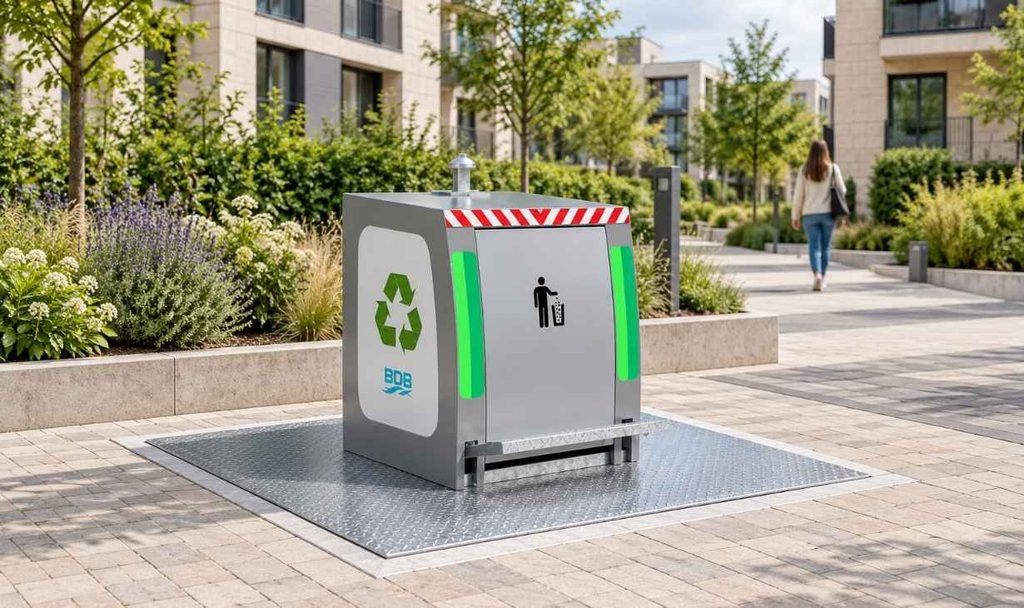
EN 13071-2 adds requirements for underground and partly underground systems because they involve an excavation, a pedestrian surface and an opening that is exposed when the container is lifted out.
Protection of the Underground Opening
When the container is lifted from its pit, the opening must not create an uncontrolled fall hazard. A safety platform, barrier or equivalent engineered solution is required. This is why an underground system should be assessed as a complete installation, not as a container placed in an excavation.
Pedestrian Safety
Underground systems are installed in pavements, squares and residential streets. The walking platform and its surroundings must be stable and slip-resistant, with no trip hazards at surface transitions.
Below-Ground Conditions and Corrosion Protection
Below ground, equipment is exposed to moisture, soil contact, rainwater and condensation, so the choice of material largely determines service life.
BDB Metal underground systems are built from ST37 sheet steel and hot-dip galvanized to EN ISO 1461. The walking platform, bottom covers and inner body are all hot-dip galvanized.
Maintenance Access
Lifting equipment, locking components, the inner body and the pit itself need planned access for inspection and servicing. This should be part of site planning from the start.
Above-Ground vs Underground Waste Containers
Both systems provide high-capacity, crane-based collection, but they suit different project priorities.
| Criterion | Above-Ground Container | Underground Container |
| Installation | Placed on a prepared, level surface | Requires a concrete pit and civil works |
| Visible footprint | Full container above ground | Most of the volume below ground |
| Infrastructure cost | Lower | Higher (excavation and pit) |
| Maintenance access | Direct | Planned access to below-ground parts |
| Urban appearance | Container remains visible | Reduced visual impact |
| Collection | Crane-based: top lift, bottom discharge | Crane-based: top lift, bottom discharge |
| Relocation | Possible | Fixed installation |
| EN 13071 parts | Part 1 + Part 3 | Part 1 + Part 2 + Part 3 |
| Typical use | Municipal collection points, institutions, commercial and industrial sites | City centres, residential developments, public squares, tourist areas |
No single system suits every project. Above-ground containers are the better fit when installation speed, lower civil-works cost or future relocation matter. Underground systems are the better fit when high capacity has to be combined with a small visible footprint in a dense urban setting.
Where to Buy EN 13071-Compliant Above-Ground and Underground Waste Containers
When choosing a supplier for an EN 13071 project, look beyond capacity. The manufacturer should be able to document lifting-connection compatibility, the bottom-discharge design, materials and corrosion protection, and provide conformity documents for the exact model.
BDB Metal manufactures both systems in Ankara and supplies municipalities, contractors and distributors in more than 40 countries.
BDB Metal Above-Ground Containers
Our above-ground waste containers are produced in five capacities:
• 2,500-litre above-ground container
• 3,000-litre above-ground container
• 3,200-litre above-ground container
• 3,750-litre above-ground container
• 5,000-litre above-ground container: the maximum capacity within the EN 13071 scope
All models are hot-dip galvanized to EN ISO 1461 and available in 1.2 mm or 2 mm sheet thickness. Optional finishes include electrostatic powder coating in RAL colours, warning graphics and custom branding.
BDB Metal Underground Containers
Our underground waste containers are available in 3,500-litre and 5,000-litre versions. Most of the collection volume stays below ground, leaving only the waste chute and walking platform visible.
• Construction: ST37 sheet steel, fully hot-dip galvanized to EN ISO 1461
• Concrete pit: Pit dimensions differ between the 3,500-litre and 5,000-litre models. Civil works should be planned according to the technical drawings for the selected model.
• Lifting connections: Kinshofer (double mushroom), double hook or F90, all compliant with EN 13071-3
• Waste chute: Spring and gas-damper mechanism, stainless steel or painted finish.
Technical drawings and conformity documents for the selected model are provided during the quotation process.
What to Request for an EN 13071 Tender
A procurement decision should not rely on a product page or catalogue alone. When a tender specifies EN 13071, request documents for the exact configuration:
• technical data sheet and dimensional drawings
• usable capacity and permissible load
• lifting connection type
• bottom-discharge and locking mechanism details
• material and coating specifications (for example, EN ISO 1461 hot-dip galvanizing)
• installation instructions and, for underground systems, pit drawings
• maintenance requirements
• EN 13071 conformity documentation for the specific model
• quality management certificates (ISO 9001, ISO 14001, ISO 45001)
A company-level quality certificate and model-specific EN 13071 conformity documentation serve different purposes, so a tender file should include both. BDB Metal’s EN 13071, EN 840, DIN and ISO certificates are listed on our certificates page.
How to Specify an EN 13071 Waste Container
Before requesting quotations, procurement teams should define the following:
1. Capacity: the required usable waste volume.
2. Installation type: above-ground or underground.
3. Waste stream: the expected non-hazardous waste type and its approximate density.
4. Collection vehicle: the crane type and lifting capacity used by the operator.
5. Lifting connection: Kinshofer, double hook, F90 or another system matching the existing fleet.
6. Emptying system: bottom-discharge and locking requirements.
7. Material specification: hot-dip galvanizing, coatings and expected corrosion exposure.
8. Site conditions: vehicle access, pedestrian traffic and overhead obstacles; for underground systems, also pit space and underground utilities.
9. Documentation: required certificates, declarations, drawings and test reports.
A detailed specification avoids buying a container that has the right volume but does not work with the existing collection fleet.
Conclusion
EN 13071 sets the technical framework for stationary waste containers up to 5,000 litres that are top lifted and bottom emptied. For above-ground containers, the key points are structural safety, permissible load, lifting connections, bottom discharge, materials and maintenance. Underground systems add requirements for the pit opening, the pedestrian platform and the below-ground environment.
The core purchasing principle is simple: an EN 13071 project should not be evaluated by container capacity alone. The container, lifting connection, collection vehicle, emptying mechanism, site and documentation must work as one compatible system.
For dimensions and technical details, see our product catalogue or contact our export team for a project-specific quotation.
Frequently Asked Questions
What is EN 13071?
EN 13071 is a European standard series covering stationary waste containers up to 5,000 litres that are lifted from the top and emptied through the bottom. Part 1 sets general requirements, Part 2 adds requirements for underground and partly underground systems, and Part 3 covers recommended lifting connections.
Does EN 13071 apply to both above-ground and underground containers?
Yes, when the container falls within the scope of the standard. Above-ground containers are assessed against Parts 1 and 3. Underground and partly underground systems must also meet the additional requirements of Part 2.
What is the maximum capacity covered by EN 13071?
The EN 13071:2019 series covers stationary, top-lifted and bottom-emptied containers with capacities of up to 5,000 litres.
What is the difference between EN 13071 and EN 840?
EN 840 covers mobile, wheeled waste containers up to 1,700 litres that are emptied by bin lifts on refuse collection vehicles. EN 13071 covers stationary containers up to 5,000 litres that are lifted by a crane and emptied through the bottom.
Which lifting connections do BDB Metal underground containers use?
BDB Metal underground containers are available with Kinshofer (double mushroom), double hook and F90 lifting connections, all compliant with EN 13071-3. The connection should be chosen to match the crane system of the operator’s collection vehicles.
What size pit does a BDB Metal underground container need?
The required concrete pit dimensions depend on whether the 3,500-litre or 5,000-litre model is selected. Refer to the technical drawings for the selected model before planning excavation and civil works.
Does BDB Metal manufacture EN 13071-compliant waste containers?
Yes. BDB Metal manufactures EN 13071-compliant above-ground and underground waste containers from hot-dip galvanized steel in Ankara, Türkiye. Capacity options include 1,250, 1,500 and 1,750 litres, alongside larger models up to 5,000 litres. Different models and customization options are available to meet regional needs and project requirements. Contact our team to confirm the available capacities and specifications for your project.

Other News
Hooklift Containers for Waste, Construction and Industrial Logistics: What Buyers Should Look For
Choosing a hooklift container is not simply a matter of...
Nov
Rear-Loading Hydraulic Garbage Truck Body Manufacturers: How to Compare Capacity, Payload and Compaction
Compare rear-loading hydraulic garbage truck bodies by usable volume, waste...
Oct
EN 13071-Compliant Above-Ground and Underground Waste Containers: A Buyer’s Guide
What EN 13071 requires from above-ground and underground waste containers,...
Oct
Recycling Bins for Hospitals: A Bulk Buying Guide
Hospital recycling bins should match the materials collected in each...
Sep
Wholesale Galvanized Waste Containers for Municipalities: The Complete EN 840 & EN 1461 Buyer’s Guide
Buying wholesale galvanized waste containers for a municipality requires more...
Sep
DIN 30720 Skip & Hooklift Containers: Dimensions, Hook Heights and Compliance Checklist
When you are purchasing containers for construction rubble, demolition waste,...
Sep
Crane-Lifted Waste Containers Explained
When you purchase an aboveground or underground waste container, capacity...
Sep
Recycling Bins for Shopping Malls: Selection and Placement
Recycling bins for shopping malls should match the waste generated...
Sep
Shopping Mall Waste Management: Collection and Storage
Shopping mall waste management needs a continuous route from shops,...
Sep