


When you purchase an aboveground or underground waste container, capacity and material are only part of the specification. If the container will be emptied by crane, the lifting connection must also match the collection vehicle and its handling equipment.
This becomes especially important when specifications mention terms such as Kinshofer, double hook, mushroom lifting system, hydraulic crane, top-lifted container or EN 13071. These terms are related, but they do not always describe the same component.
At BDB Metal, we recommend evaluating the container, lifting interface and collection vehicle as one complete waste-management system rather than selecting each element independently. Correct compatibility can simplify collection operations, reduce equipment conflicts and make future fleet planning considerably easier.
Table Of Content
What Is a Crane-Lifted Waste Container?
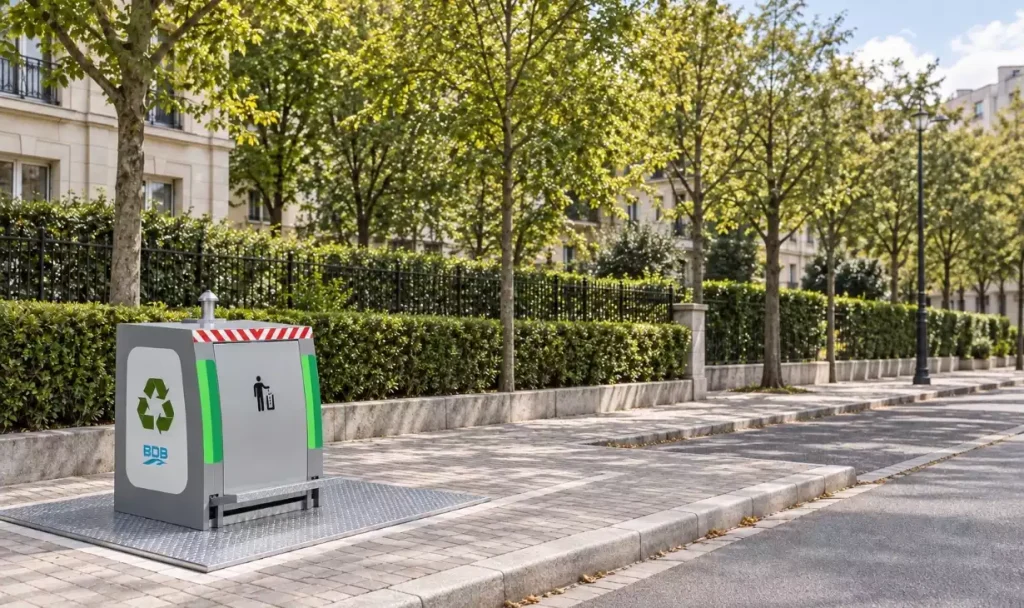
A crane-lifted waste container is a stationary container designed to be picked up vertically by a crane or dedicated container-handling attachment during collection.
In many systems, the crane raises the container above the collection vehicle and the bottom discharge mechanism is then opened to release the waste. This type of configuration is commonly found in large-capacity aboveground, semi-underground and fully underground waste systems.
EN 13071-1 specifically covers stationary waste containers up to 5,000 litres that are top lifted and bottom emptied for solid non-hazardous waste. The standard addresses general characteristics, testing and safety requirements.
For underground installations, the lifting operation is particularly important because the inner waste container must be removed vertically from its underground chamber before it can be emptied.
Our underground waste container systems are designed around this collection principle. The waste remains below ground during normal use, while crane-equipped collection vehicles remove the inner container during servicing.
Why Does the Lifting System Matter When Buying a Waste Container?
The lifting interface determines how the crane connects to the container. If the interface on the container does not match the attachment installed on the collection vehicle, the container may not be operable without modifying the fleet, replacing equipment or changing the lifting arrangement.
For buyers, this means that the question should not simply be: “Which waste container should I buy?” A more useful question is: “Which waste container is compatible with the crane and lifting system used by my collection fleet?”
Before placing an order, we recommend checking the existing vehicle fleet, crane configuration, lifting attachment, container capacity, required discharge mechanism and applicable procurement standard.
This is particularly important for municipalities and operators that already have multiple collection vehicles in service. Our guide to garbage truck dimensions and container compatibility provides additional context on why container and vehicle compatibility should be considered together.
Kinshofer, Mushroom and Double-Hook: What Is the Difference?
One source of confusion during procurement is that Kinshofer, mushroom and double-hook are sometimes treated as interchangeable terms. They should be distinguished more carefully.
Kinshofer is a manufacturer of crane attachments and container-discharge equipment. The company produces handling units for different interfaces, including ring systems and the KINSHOFER mushroom system. Its current product documentation also includes combination equipment capable of handling more than one connection type.
A mushroom connection, by contrast, describes a particular lifting-connection geometry. EN 13071-3 includes requirements relating to mushroom lifting connections and their compatibility with the handling system.
A hook or double-hook configuration uses loops, hooks or corresponding lifting points rather than the same mushroom-type geometry. EN 13071-3 covers various loop configurations as well as mushroom connections for top-lifted, bottom-emptied stationary containers.
In practical purchasing terms, asking for a “Kinshofer container” alone may therefore be insufficient. You should specify the exact container connection and confirm that it matches the crane attachment that will perform the lifting and discharge operation.
Kinshofer Mushroom Lifting Systems
The Kinshofer mushroom system uses dedicated mushroom-shaped lifting elements that interact with a compatible container-discharge attachment. Kinshofer currently describes dedicated equipment for containers using its mushroom system, including the KM 920-12, while its KM 921 combination unit can operate with both ring and Kinshofer mushroom systems.
For operators already using compatible Kinshofer equipment, selecting containers with the corresponding lifting arrangement can help maintain consistency across the collection fleet. However, compatibility should never be assumed from visual similarity alone. Kinshofer itself specifies dimensional and equipment requirements for safe use of its mushroom-based handling systems.
When requesting a quotation from us, providing the crane attachment model, photographs of the existing lifting equipment or technical drawings can make compatibility assessment much more precise.
Double-Hook Lifting Systems
A double-hook system uses two defined lifting or operating points and can be encountered in municipal and recycling-container applications. Its main practical advantage is familiarity: many waste operators already have crane equipment designed around hook or loop-based connections. However, “double hook” should not be used as a universal specification. The distance between lifting points, geometry of the connection, opening mechanism and attachment design all matter.
EN 13071-3 recognizes different loop configurations and provides dimensional requirements for specified lifting connections. This is why procurement documents should identify the actual interface rather than relying only on a generic term such as “hook lifting.”
For an international project, we recommend sharing both the tender specification and the technical details of the collection equipment before production begins.
Mushroom Lifting Connections
A mushroom lifting connection provides a defined mechanical interface between the container and the handling equipment.
EN 13071-3 specifically includes mushroom lifting connections within its scope. The standard addresses both the connection itself and compatibility between the mushroom and the container-handling system.
The important point for a buyer is that “mushroom” describes an interface family, not automatic compatibility with every crane attachment marketed for waste containers.
You therefore need to confirm the dimensions, handling equipment and locking or discharge arrangement required by your collection fleet.
This distinction is especially relevant when importing containers, adding new containers to an existing municipal network or preparing specifications for a long-term waste-management contract.
Kinshofer vs Double-Hook vs Mushroom: Quick Comparison
| Criterion | Kinshofer-Compatible System | Double-Hook System | Mushroom Connection |
| What the term mainly describes | Handling equipment/system compatibility | Hook or loop-based lifting arrangement | Lifting-connection geometry |
| Typical application | Crane-lifted waste and recycling containers | Municipal and stationary crane-lifted containers | Top-lifted, bottom-emptied stationary containers |
| Key buying question | Which Kinshofer attachment/model is installed? | What hook geometry and spacing are required? | Which mushroom geometry and handling unit are required? |
| EN 13071 relevance | Depends on the container/interface configuration | Loop connections are addressed in EN 13071-3 | Mushroom connections are addressed in EN 13071-3 |
| Should compatibility be checked before ordering? | Yes | Yes | Yes |
The most important conclusion is simple: choose the lifting interface according to the collection equipment that will actually empty the container.
What Does EN 13071 Mean for Crane-Lifted Waste Containers?
EN 13071 is particularly relevant when purchasing stationary, top-lifted and bottom-emptied waste containers for municipal or commercial collection systems. The series separates different technical aspects of the system.
EN 13071-1 covers general requirements for stationary waste containers up to 5,000 litres. EN 13071-3 focuses more specifically on lifting and opening, closing or locking connections used during loading and unloading.
For underground and partly underground systems, the EN 13071 series also contains requirements specific to those installations. If your tender or project specification requires EN 13071, we recommend stating the relevant part of the standard rather than writing only “EN 13071 compliant.” That allows manufacturers and procurement teams to evaluate exactly which requirements apply to the intended container and lifting configuration.
It is also worth noting that the 2019 parts of EN 13071 are currently subject to a standards revision process. Buyers working on long-term projects should therefore verify the applicable edition when preparing final tender documentation.
Can Underground Waste Containers Use Hydraulic Crane Systems?
Yes. Underground waste containers can be designed for collection using hydraulic crane-equipped vehicles. In these systems, the crane lifts the internal container vertically from the underground structure and positions it over the collection vehicle for emptying.
For example, our 5000L Underground Waste Container is designed with discharge clearance suitable for hydraulic crane-equipped collection vehicles. The model provides a 5,000-litre underground waste-storage solution for projects where large capacity and reduced surface occupation are required.
BDB Metal also manufactures a 3,500-litre underground model whose published technical information identifies Kinshofer double-mushroom, double-hook and F90 lifting options. This makes the lifting configuration an important item to discuss during the technical quotation stage rather than after the installation has already been planned.
Aboveground or Underground: Which Crane-Lifted Container Should You Choose?
The choice depends primarily on the site. Aboveground large-volume containers can be appropriate where excavation is not desirable, installation must remain relatively simple or infrastructure needs to be relocated later.
Underground containers are generally considered where planners want to keep most of the storage volume below street level, reduce the visible footprint of the waste system and provide larger collection capacity within an urban environment.
At BDB Metal, our overall waste container range includes both aboveground and underground container models. Our published range includes aboveground metal containers as well as 3,500L and 5,000L underground systems.
For crane-lifted projects, however, the final choice should also take into account the collection vehicle, lifting attachment and required standard. We recommend confirming the exact lifting configuration with our technical team before ordering project quantities.
What Should You Check Before Ordering a Crane-Lifted Waste Container?
Before requesting production, confirm the following information:
- Container type: aboveground, semi-underground or underground.
- Required capacity: including expected waste volume and collection frequency.
- Crane type: especially the crane and attachment already installed on the collection vehicle.
- Lifting interface: mushroom, hook/loop, double-hook or another specified connection.
- Opening mechanism: how the container’s bottom discharge doors will be operated.
- Applicable standard: including the relevant part and edition of EN 13071 where required.
- Container material: galvanized steel, alternative inner-container construction or project-specific configuration.
- Installation dimensions: particularly excavation and clearance requirements for underground systems.
- Vehicle access: crane reach, positioning area, overhead clearance and collection-route conditions.
- Documentation: technical drawings, tender specifications and any required certification.
Material selection also affects long-term container performance. If corrosion resistance and service life are major purchasing criteria, our guide on choosing long-lasting metal waste containers explains the key construction factors that buyers should evaluate.
Where Can You Buy Crane-Lifted Underground Waste Containers from Turkey?
If you are sourcing crane-lifted underground waste containers from a Turkish manufacturer, BDB Metal can work with municipalities, waste-management operators, contractors, distributors and project buyers on technical container specifications.
We manufacture waste-container systems in Turkey and supply international projects. Our current product portfolio includes 3,500L and 5,000L underground waste containers as well as a broader range of municipal waste and recycling equipment.
For projects involving Kinshofer, double-hook, mushroom or hydraulic crane collection, we recommend sending us your collection-vehicle and lifting-system specifications together with the required container capacity. This allows us to evaluate the project based on actual lifting compatibility, rather than asking you to select a container from capacity alone.
Municipal buyers planning a wider collection network can also review our guide to recycling bins for municipalities when considering how individual containers fit into the overall waste-management infrastructure.
How We Approach Crane-Lifted Waste Container Projects at BDB Metal
At BDB Metal, we treat the lifting connection as part of the container specification, not as a minor accessory. When you contact us for a project, the most useful information you can provide includes the required capacity, installation environment, waste type, crane equipment, lifting attachment and applicable tender standard.
For underground systems, project drawings and excavation conditions are also important. For existing fleets, crane and attachment details help us understand the interface that your containers need to work with.
Our goal is to help you select a system that is technically appropriate for the way the containers will actually be collected.
Conclusion
Kinshofer, double-hook and mushroom lifting systems all relate to crane-based waste collection, but they should not be treated as identical specifications.
A Kinshofer system refers to compatible container-handling equipment and associated interfaces. A mushroom connection describes a particular lifting geometry addressed within EN 13071-3. A double-hook or loop-based arrangement uses a different connection method and must likewise match the handling equipment installed on the collection vehicle.
For buyers, the safest procurement approach is to evaluate the container, lifting connection, crane attachment and collection vehicle together.
If you are planning an aboveground or underground waste-container project, you can share your technical specification with BDB Metal. We can evaluate capacity, installation conditions and lifting-system requirements before the quotation stage so that the proposed configuration is based on the needs of your collection operation.
Frequently Asked Questions
What is a Kinshofer waste container lifting system?
Kinshofer manufactures crane attachments and container-discharge equipment used in waste and recycling operations. Its range includes equipment designed for ring connections and the Kinshofer mushroom system. When specifying a Kinshofer-compatible container, the exact handling attachment and connection geometry should also be confirmed.
What is a mushroom lifting system for waste containers?
A mushroom lifting system uses a mushroom-shaped connection between the waste container and compatible crane-handling equipment. Mushroom lifting connections are addressed in EN 13071-3 for top-lifted, bottom-emptied stationary waste containers. The actual dimensions and handling-system compatibility must be checked before purchasing.
What is a double-hook waste container system?
A double-hook system uses hook or loop-based lifting points to handle and discharge a waste container. The exact arrangement varies according to the equipment being used, so buyers should confirm hook geometry, spacing and discharge operation with both the container manufacturer and vehicle-equipment supplier.
Are underground garbage containers compatible with hydraulic cranes?
They can be. Underground waste systems commonly use crane-equipped collection vehicles to lift the internal waste container vertically from the underground chamber. BDB Metal’s 5,000L underground container specifies discharge clearance compatible with hydraulic crane-equipped collection vehicles.
Does EN 13071 cover underground waste containers?
The EN 13071 series covers stationary top-lifted and bottom-emptied waste containers up to 5,000 litres, with different parts addressing general, underground/partly underground and lifting-related requirements. Buyers should identify the specific part required by their tender or project rather than referring only to EN 13071 in general.
Does BDB Metal manufacture underground waste containers in Turkey?
Yes. BDB Metal’s current product range includes 3,500L and 5,000L underground waste-container systems, and the company supplies waste-management equipment for municipal and international projects.
Can I order a BDB Metal container for an existing crane-equipped fleet?
The correct configuration depends on the crane attachment and lifting interface already used by the fleet. We recommend sending BDB Metal the crane model, attachment information, technical drawings or photographs and required container capacity so compatibility can be evaluated during the quotation process.

Other News
Wholesale Galvanized Waste Containers for Municipalities: The Complete EN 840 & EN 1461 Buyer’s Guide
Buying wholesale galvanized waste containers for a municipality requires more...
Sep
DIN 30720 Skip & Hooklift Containers: Dimensions, Hook Heights and Compliance Checklist
When you are purchasing containers for construction rubble, demolition waste,...
Sep
Crane-Lifted Waste Containers Explained
When you purchase an aboveground or underground waste container, capacity...
Sep
Recycling Bins for Shopping Malls: Selection and Placement
Recycling bins for shopping malls should match the waste generated...
Sep
Shopping Mall Waste Management: Collection and Storage
Shopping mall waste management needs a continuous route from shops,...
Sep
Recycling Bins for Hotels: A Practical Buying Guide
Recycling bins for hotels need to work for both guests...
Sep
Hotel Waste Management: A Practical Planning Guide
Hotel waste management connects waste prevention, separation, internal collection and...
Sep
Recycling Symbols 1–7 Explained: What They Mean on Packaging and Bins
Recycling symbols on packaging and bins carry specific information about...
Jun
Recycling Bins for Municipalities: The Right Model for Every Public Space
Recycling bins for municipalities must serve a wide range of...
Jun