


Hospital recycling bins should match the materials collected in each area, the space available and the cleaning team’s emptying schedule. For procurement teams and facility managers, the priority is to specify equipment that patients, visitors and staff can use clearly and that cleaning teams can service efficiently.
This guide covers recycling bins for hospitals’ public and staff areas, including lobbies, waiting rooms, offices and cafeterias. It focuses on accepted non-hazardous recyclables and associated general waste collection. These stations do not replace dedicated containers for sharps, infectious waste, pharmaceuticals or other specialist healthcare waste.
Table Of Content
How to Choose a Hospital Recycling Bins Supplier
A hospital recycling bins supplier should provide a model-by-model quotation, clear material specifications and confirmation of the custom features included. For a multi-floor project, ask whether different bin configurations can share the same finish and labelling, and whether the supplier can fulfil the required quantities within your project timetable.
Buying directly from a manufacturer can make it easier to discuss dimensional changes and production details. A distributor may offer suitable stocked products or local support. Compare what each supplier actually includes: drawings, sample arrangements, replacement components, packaging and delivery terms. Manufacturer status alone does not establish product suitability.
Choose hospital recycling bins by confirming the accepted waste streams first, then specifying compartments, usable capacity, cleaning access and placement. Review the proposed equipment with the hospital’s facilities, cleaning and infection prevention teams before ordering.
Begin with a short assessment of what each location produces. Drinks packaging in a waiting room creates a different requirement from office paper or food residues in a cafeteria. Confirm with the recycling contractor which materials can share a compartment and which need separate collection. The Healthcare Plastics Recycling Council’s equipment guide similarly recommends discussing compatible waste streams with the recycling partner when assessing equipment needs.
Multi-stream recycling bins provide separate compartments for different materials, but additional compartments only help when those streams are collected. Where both are needed, provide an identifiable general waste option alongside recycling. Within a hospital recycling program, the collection team must also preserve that separation after emptying each station.
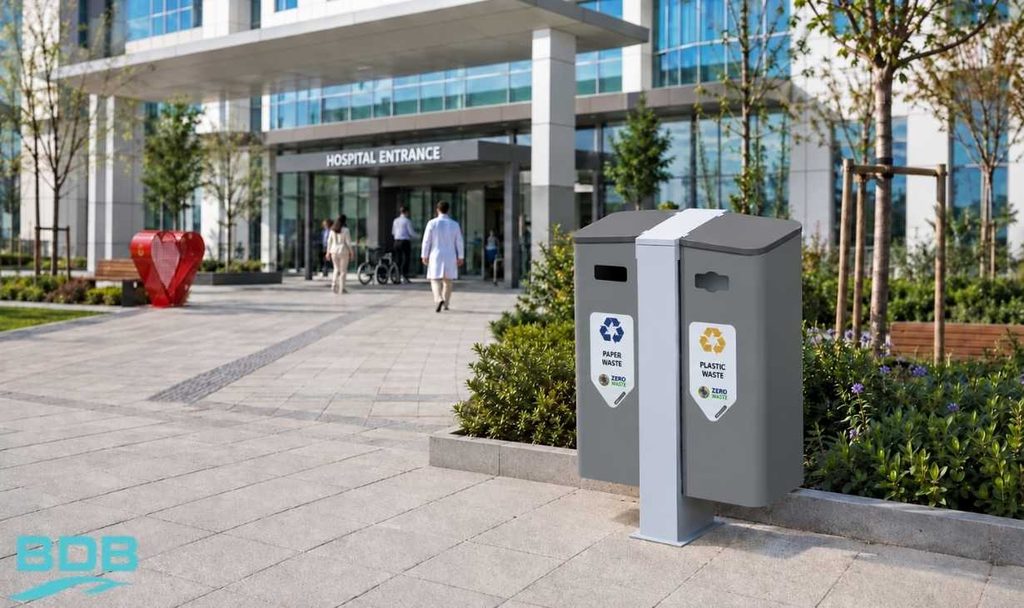
Choose Hospital Recycling Bin Models by Location
Specify recycling stations by location rather than repeating one configuration throughout the building. The following examples are starting points to confirm against the hospital’s collection arrangements.
| Hospital area | Materials to assess | Bin specification priorities |
| Lobbies and reception | Drinks containers, accepted packaging and general waste | Visible labels, compact footprint and coordinated appearance |
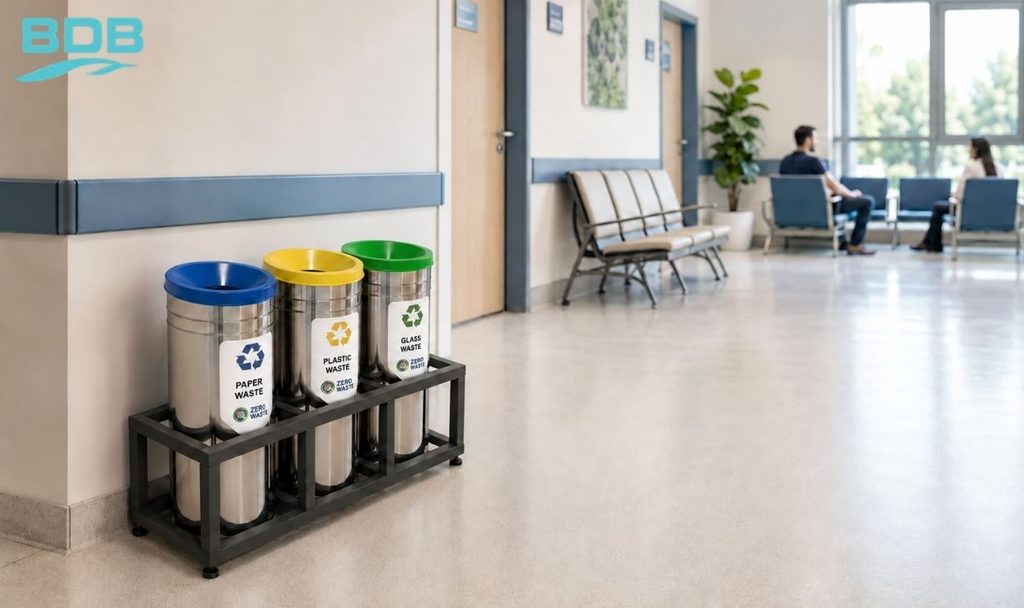
| Outpatient waiting areas | Bottles, paper and takeaway packaging | Simple sorting choices, suitable openings and unobstructed access |
| Administrative offices | Non-confidential paper, packaging and general waste | Compartments matched to office collection; confidential documents follow a separate secure route |
| Staff rooms | Drinks containers, food packaging and general waste | Easy servicing and capacity suited to shift changes |
| Cafeterias | Accepted packaging, food waste and residual waste | Clearly differentiated openings; food and liquids handled through the site’s agreed system |
| Gardens and entrance approaches | Drinks packaging and general waste | Outdoor finish, rain protection and an appropriate fixing arrangement |
For a three-stream layout, review the Standard 3-Piece Recycling Bin Set. Where four separately collected streams are needed, compare the Standard 4-Piece Recycling Bin Set. Both product pages list ST37 sheet metal, electrostatic powder coating, optional sizing and customer-specific foil labels. Confirm usable capacity and the final dimensions in the quotation; a three-piece set is not automatically the right choice for every waiting area.
BDB Metal’s indoor recycling bins include single units and grouped configurations for different layouts. Keep public recycling points distinct from clinical disposal points so their purpose is clear.
Plan Quantities and Capacity for Bulk Recycling Bin Orders
Capacity should cover the volume each waste stream generates between emptying rounds, with an allowance based on observed peaks. Measure individual compartments: a station can have spare capacity overall while its bottle section overflows.
For example, a compartment receiving approximately 45 litres between rounds cannot be served by a 40-litre liner without changing the collection schedule. Treat this as an illustrative calculation, not a standard hospital bin size. Check actual fill levels during busy outpatient periods, visiting hours and staff breaks.
Count collection points before calculating the order quantity. Specify whether “one unit” means one individual bin or a complete multi-bin set: 12 three-bin stations contain 36 individual bins, which can otherwise lead to mismatched quotations.
For example, an initial schedule might include two lobby stations, eight waiting-area stations and six office stations: 16 stations in total, with the configuration listed separately for each location. These are illustrative quantities, not recommendations based on hospital size. Add any spare units as a separate line rather than hiding them in the area totals.
Request usable capacity per compartment, external dimensions and space needed to remove a filled bag or inner bucket. Record bag weight as well as volume, and review handling with the cleaning team. A larger unit is only useful if staff can empty it safely within the available space.
Specify Metal Recycling Bins for Cleaning and Daily Use
Evaluate metal recycling bins by their construction and maintenance requirements, not appearance alone. Specify the metal, sheet thickness and surface finish, and ask the supplier to confirm compatibility with the cleaning products and methods used at the hospital.
Check how staff access internal surfaces and replace bags. Removable inner buckets, bag-retention systems and service doors are options to assess against the selected model; do not assume every unit includes all three. Ask for a sample or drawing showing the servicing arrangement before approving a bulk order.
Review stability and any fixing requirements at each location. For gardens and exposed entrances, assess corrosion protection, rain exposure and anchoring separately using the outdoor recycling bin range.
Custom Recycling Bins: Colours, Labels and Hospital Branding
Use short material names, recognisable pictograms and examples of items accepted by the collection service. Colour should support those instructions, with the scheme agreed for the destination facility rather than copied from another country.
Clear differentiation matters in healthcare settings. NHS Property Services identifies the disposal of general and recyclable waste in clinical waste streams as a source of lost recycling opportunities and higher processing costs.
Keep the same compartment order across comparable hospital recycling stations. Custom recycling bins can carry hospital logos and multilingual labels, but branding should leave disposal instructions prominent.
Position units where users can see and reach the openings without obstructing wheelchairs, patient transport routes or emergency access. Check the approach from a seated position as well as standing height. Review misplaced items and overflowing compartments after installation; practical feedback helps improve recycling in hospitals more than adding further labels without investigating the problem.
Request and Compare Quotes for Bulk Hospital Recycling Bins
For bulk recycling bins, send the same specification to each shortlisted supplier. A description such as “hospital recycling station” leaves too much open to interpretation. Use a schedule that makes the required product, accessories and delivery scope explicit.
| Quote item | Information to request | Why it matters |
| Model and quantity | Product reference, number of stations and bins per station | Prevents sets and individual bins being counted differently |
| Capacity and dimensions | Litres per compartment, external dimensions and servicing clearance | Confirms both usable volume and site fit |
| Metal and finish | Material type, sheet thickness, surface treatment and coating | Allows comparison beyond product photographs |
| Inner arrangement | Inner buckets or bag holders, lids and service doors included | Identifies features that may otherwise be optional extras |
| Customisation | RAL codes, logo artwork, label languages, pictograms and openings | Defines the approved appearance and sorting system |
| Minimum order | Minimum quantity per model and per customised version | Checks whether a mixed-model hospital order is feasible |
| Approval | Drawing revision, sample availability, sample cost and approval stage | Records exactly what production will follow |
| Production and delivery | Lead time after approval, shipment stages and delivery destination | Aligns the order with refurbishment or opening dates |
| Packaging and freight | Packed dimensions, weights, protection and quoted shipping terms | Makes international quotations easier to compare |
Separate the product total, customisation, packaging and transport in the quotation. A lower unit price may exclude inner buckets or freight included elsewhere. Confirm which taxes, import costs and unloading arrangements are outside the supplier’s scope before comparing the delivered totals.
Browse the BDB Metal recycling product catalogues to identify candidate models, then request an itemised specification for the selected products. Catalogue photographs should support, rather than replace, the agreed technical drawing.
For projects covering several buildings, approve a representative unit before repeating the specification. Ask the hospital recycling bins supplier to identify which features are standard and which require custom production, then confirm lead times and shipping arrangements in the quotation.
BDB Metal: Recycling Bins Manufacturer for Hospital Projects
BDB Metal is a recycling bins manufacturer in Türkiye supplying indoor and outdoor units for institutional projects. Its metal range includes single and grouped models, with project-specific dimensions, RAL colours, logos and pictograms available according to the selected design.
For buyers specifying recycling bins for healthcare facilities, this allows a coordinated appearance across public and staff areas while adapting configurations to each location. Plastic, polycarbonate or cardboard alternatives can also be included in the project scope on request, subject to application suitability.
BDB Metal exports to more than 40 countries and works with international buyers on custom and bulk equipment requirements. Share your locations, waste streams, quantities, preferred specifications and delivery destination to discuss suitable options for your hospital project.

Other News
Recycling Bins for Hospitals: A Bulk Buying Guide
Hospital recycling bins should match the materials collected in each...
Sep
Wholesale Galvanized Waste Containers for Municipalities: The Complete EN 840 & EN 1461 Buyer’s Guide
Buying wholesale galvanized waste containers for a municipality requires more...
Sep
DIN 30720 Skip & Hooklift Containers: Dimensions, Hook Heights and Compliance Checklist
When you are purchasing containers for construction rubble, demolition waste,...
Sep
Crane-Lifted Waste Containers Explained
When you purchase an aboveground or underground waste container, capacity...
Sep
Recycling Bins for Shopping Malls: Selection and Placement
Recycling bins for shopping malls should match the waste generated...
Sep
Shopping Mall Waste Management: Collection and Storage
Shopping mall waste management needs a continuous route from shops,...
Sep
Recycling Bins for Hotels: A Practical Buying Guide
Recycling bins for hotels need to work for both guests...
Sep
Hotel Waste Management: A Practical Planning Guide
Hotel waste management connects waste prevention, separation, internal collection and...
Sep
Recycling Symbols 1–7 Explained: What They Mean on Packaging and Bins
Recycling symbols on packaging and bins carry specific information about...
Jun