


Shopping mall waste management needs a continuous route from shops, restaurants and public areas to central storage and vehicle collection. Separating materials at the first bin achieves little if they are mixed together during transfer.
For mall operators, the priority is to connect tenant responsibilities, cleaning rounds, container capacity and collection access. This guide explains how to plan that connection and specify the equipment needed, without treating every part of the building as the same waste collection environment.
Table of Content
Build a Shopping Mall Waste Management Plan Around Actual Waste
Begin with a waste assessment covering shops, food outlets, public areas and offices. Record the materials generated, their approximate quantities, peak periods and current collection arrangements. The US EPA identifies waste assessment as a way to understand a building’s waste composition and select suitable improvements. EPA waste assessment guidance
Effective waste management for shopping centres should also reduce what enters the collection system. Discuss reusable delivery packaging with tenants and review avoidable food waste with catering operators.
Separate the plan by waste stream: cardboard, accepted recyclable packaging, food waste and residual waste. Batteries, electrical equipment and maintenance chemicals need their own agreed handling routes; do not treat them as ordinary mixed mall waste.
Assign Collection Duties and Transfer Points
A shopping centre waste management plan should explain who moves each material, where it is handed over and when it must leave the area.
| Waste source | Collection arrangement | Transfer or storage requirement |
| Retail deliveries | Tenants separate cardboard and accepted packaging | Designated dry collection point, outside access routes |
| Public sorting stations | Cleaning staff remove each stream separately | Identified containers that preserve separation |
| Food outlets | Catering teams follow the agreed food waste procedure | Suitable closed containers and scheduled transfers |
| Offices and staff rooms | Staff sort materials; cleaning teams collect | Transfer to the corresponding central stream |
| Central waste area | Site team prepares containers for collection | Compatible vehicle access and a clear collection schedule |
| Entrances, gardens and car park walkways | Cleaning teams empty outdoor litter bins on scheduled rounds | Suitable outdoor bins linked to the internal collection route |
This is the operational core of waste management in shopping malls. Include delivery peaks and weekend trading in the schedule, and make the handover rules part of tenant onboarding.
Include Indoor and Outdoor General Waste Bins
Shopping mall waste management starts in visitor areas, not at the loading bay. Provide clearly identified general waste bins alongside recycling wherever both are needed.
For indoor mall garbage cans, check bag retention, cleaning access and convenient emptying. Position bins where visitors can find them without obstructing shop entrances, circulation or emergency access.
Outdoor litter bins serve entrances, gardens, open seating areas and car park walkways. Metal or wood-clad models should be assessed for weather exposure, stability, anchoring and ease of emptying. Where smoking is permitted, consider a purpose-designed ashtray compartment separate from the general waste receptacle.
Compare BDB Metal’s trash cans by location and operating conditions. Include each outdoor point in the cleaning schedule so waste does not accumulate beyond the building’s interior.
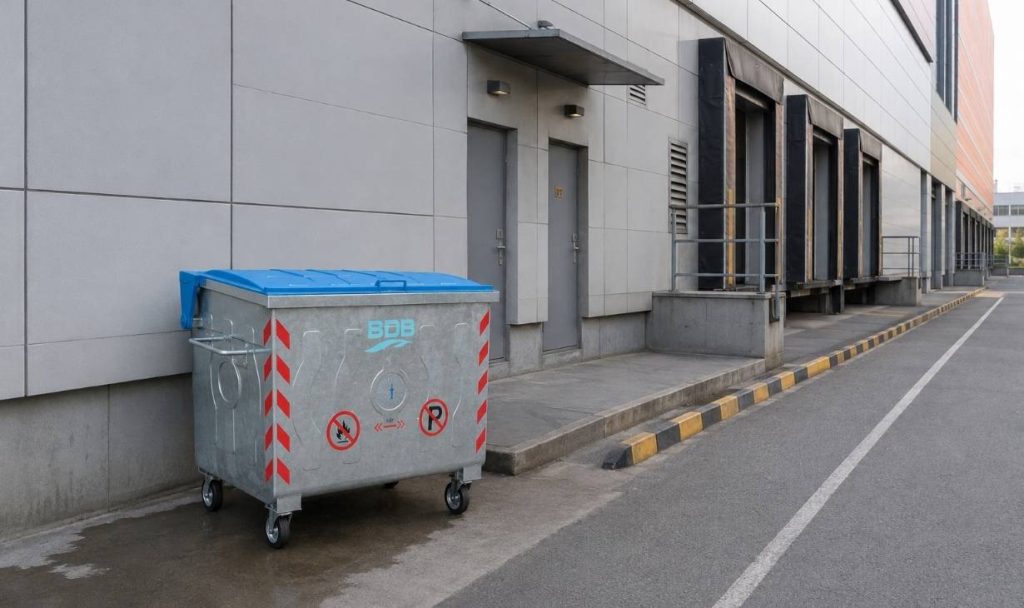
Choose Containers That Fit the Service Route
Onsite waste management for shopping malls often requires wheeled containers to move materials through service corridors and loading areas. Before selecting capacity, measure doorways, turning points, ramps and service lift dimensions and load limits.
Compare metal waste containers and plastic waste containers against the proposed load, cleaning routine and handling conditions. Check lid operation, wheel specification, brakes and compatibility with any lifting equipment.
A container that fits inside a lift may still be difficult to turn through its entrance. Review the complete route with the cleaning team, including the container when loaded. Separately collected materials must remain identifiable throughout the journey.
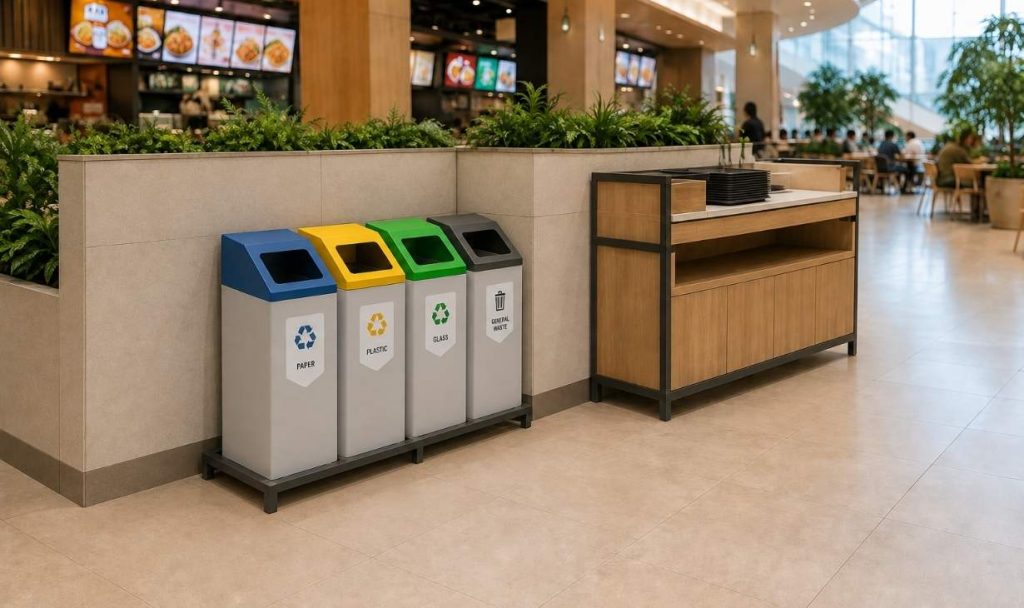
Plan Around Service Peaks
Food court waste management needs a different rhythm from cardboard collection. Check bins and transfer points around lunch, dinner and closing, then adjust the rounds to the observed volumes.
Keep food residues out of dry recyclable streams and arrange suitable containers for liquids or used cooking oil where required. Do not assume that packaging labelled compostable is accepted by the site’s food waste processor.
Assign responsibility for spill response, container washing and reporting damaged lids. Extra storage capacity is not a substitute for suitable emptying intervals when food waste is involved.
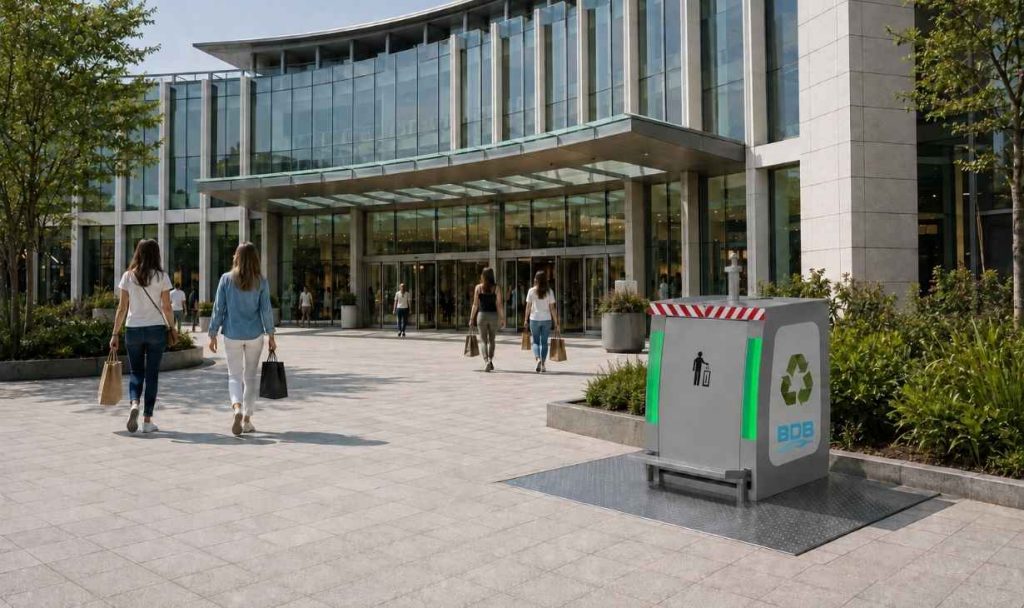
Size Central Storage and Confirm Vehicle Compatibility
Shopping center waste management requires storage that matches the time between external collections, not just the volume generated during one cleaning shift.
As an illustrative planning calculation, a stream producing 1,200 litres per day would require 2,400 litres for a two day collection interval. An assumed 25% contingency would increase that to 3,000 litres. Validate the allowance against actual peaks and missed collection arrangements, then check allowable load as well as volume.
Calculate each stream separately. Review the transfer method too: staff must be able to load the central container using the intended procedure.
BDB Metal’s above ground waste containers include capacities from 2,500 to 5,000 litres. For crane emptied models, confirm the lifting connection, vehicle approach and operating clearance with the collector before purchase.
Underground waste containers may suit projects where visual integration matters, but require site assessment, excavation planning, drainage and maintenance access. Above ground placement also needs a suitable base and an agreed collection area.
Set Control Measures and Review Performance
Useful control measures for waste management in shopping centres include:
- Checking container fill levels before peak trading periods.
- Keeping waste streams identifiable during every transfer.
- Keeping collection and maintenance access clear.
- Assigning inspections for leaks, damaged wheels and lids.
- Recording contamination, overflow and missed collections.
- Giving tenants feedback when separation problems recur.
Shopping centre waste management should be reviewed against these records. If containers repeatedly overflow, establish whether the cause is insufficient capacity, a missed round or unexpected tenant volumes before buying more equipment.
Track collected quantities by stream alongside operational problems. Do not describe everything placed in a recycling container as successfully recycled; confirm outcomes through the collector’s reporting.
Specify the Equipment for Your Site
Send suppliers the waste profile, collection intervals, proposed capacities, route measurements, loading method, vehicle details and delivery location. Identify which products will be used for internal transfer and which will remain at central storage.
Waste Container Manufacturing for Shopping Mall Projects
BDB Metal manufactures metal waste containers and supplies equipment for visitor areas, internal transfer and central storage. The range includes indoor and outdoor trash cans, wheeled plastic containers, galvanised metal containers and above-ground or underground systems. Equipment can be selected around the mall’s layout, waste volumes, cleaning routes and collection vehicle requirements.
With four factories in Ankara, Türkiye, a monthly production capacity of 12,000 metal waste containers and exports to more than 40 countries, BDB Metal offers manufacturing capacity and international supply experience for large commercial projects.
Share your indoor and outdoor collection points, waste volumes, service-route dimensions, vehicle requirements and delivery destination to discuss equipment for your site.
For public sorting points, see our guide to recycling bins for shopping malls.

Other News
Recycling Bins for Hospitals: A Bulk Buying Guide
Hospital recycling bins should match the materials collected in each...
Sep
Wholesale Galvanized Waste Containers for Municipalities: The Complete EN 840 & EN 1461 Buyer’s Guide
Buying wholesale galvanized waste containers for a municipality requires more...
Sep
DIN 30720 Skip & Hooklift Containers: Dimensions, Hook Heights and Compliance Checklist
When you are purchasing containers for construction rubble, demolition waste,...
Sep
Crane-Lifted Waste Containers Explained
When you purchase an aboveground or underground waste container, capacity...
Sep
Recycling Bins for Shopping Malls: Selection and Placement
Recycling bins for shopping malls should match the waste generated...
Sep
Shopping Mall Waste Management: Collection and Storage
Shopping mall waste management needs a continuous route from shops,...
Sep
Recycling Bins for Hotels: A Practical Buying Guide
Recycling bins for hotels need to work for both guests...
Sep
Hotel Waste Management: A Practical Planning Guide
Hotel waste management connects waste prevention, separation, internal collection and...
Sep
Recycling Symbols 1–7 Explained: What They Mean on Packaging and Bins
Recycling symbols on packaging and bins carry specific information about...
Jun