


Recycling bins for hotels need to work for both guests and the teams servicing them. A compact room bin, a lobby recycling station and a kitchen service container perform different jobs, but their selection should follow one coordinated plan.
The purchasing decision involves more than appearance and capacity. Compartment layout, material, labels, cleaning access and onward collection all influence whether the equipment works in practice.
The short answer: A hotel needs more than recycling bins. It needs a connected waste collection system, from separation at the source to internal transfer and central storage.
Table Of Content
How to Choose Recycling Bins for Hotels
Start with the waste generated in each area and the materials your collection provider accepts. Then match the equipment to available space, emptying frequency and staff access.
More compartments do not automatically improve separation. A simple two-stream arrangement may suit guest rooms, while a larger station serves meeting spaces or dining areas. The correct configuration depends on the collection scheme.
Use this area-by-area guide to prepare an initial equipment schedule:
| Hotel area | Recycling requirement | Suitable recycling bin |
| Guest rooms | Compact and easy-to-understand separation | Single or two-compartment recycling bin |
| Lobby and reception | Visible separation compatible with the interior | Enclosed metal or custom-designed recycling station |
| Restaurants and breakfast areas | Clear guidance during concentrated use | Two- or three-compartment recycling station |
| Meeting and event spaces | Flexible capacity for changing visitor numbers | Modular or multi-compartment recycling units |
| Corridors and floor service areas | Convenient separation without obstructing circulation | Compact indoor recycling bins |
| Staff and office areas | Functional separation for predictable waste streams | Clearly labelled plastic, metal, polycarbonate or cardboard bins |
| Gardens, pool areas and terraces | Weather-resistant separation | Outdoor metal or wood-clad recycling units |
Recycling bins cover the point at which waste is separated, but they are only one part of the hotel’s waste collection system. Housekeeping transfer equipment, kitchen containers and central storage should be planned separately so that materials separated by guests remain separate until collection. For these operational requirements, see our hotel waste management planning guide.
Recycling Bins for Hotel Rooms
Recycling bins for hotel rooms should make the choice clear within a few seconds. Too many compartments can occupy valuable floor space and leave guests uncertain about where an item belongs.
A compact two-compartment bin can simplify the decision. Depending on the collection arrangement, it might separate paper and other waste, or mixed accepted recyclables and other waste. A paper-only section must not be labelled as accepting all recyclables.
When comparing hotel room recycling bins, check the footprint beside the desk or furniture, not just the listed capacity. The unit should remain visible without interfering with luggage space or circulation.
In-room recycling bins also need to suit housekeeping. Check bag retention, access to each compartment and the space needed to remove a full bag. Do not assume every model includes removable inner buckets; specify the liner or bag arrangement required.
Before ordering for every room, trial a sample. Ask housekeeping to assess emptying and cleaning, and check whether guests can see the labels in its intended position.
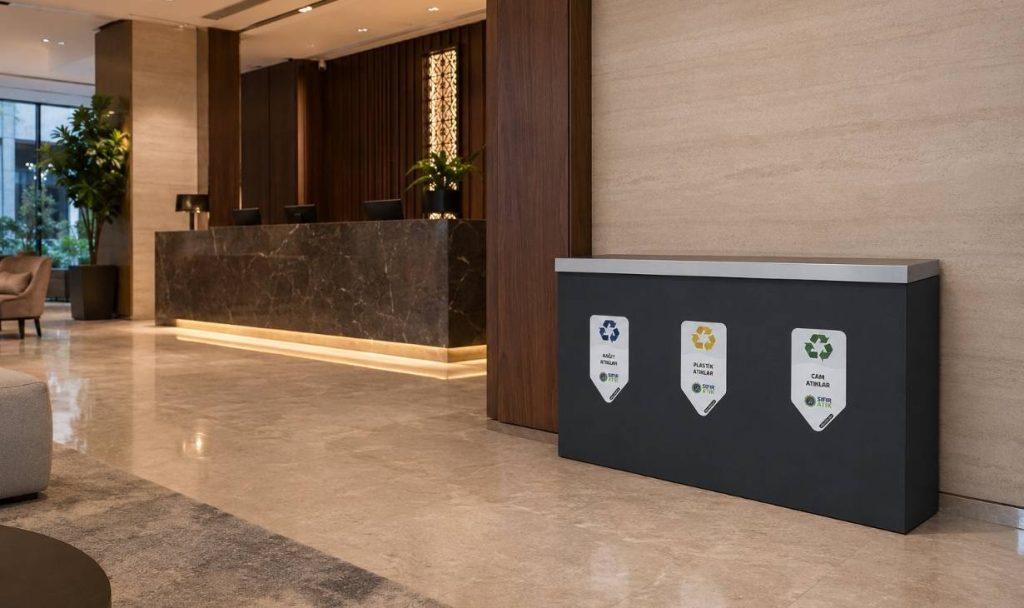
Choose Stations for Lobbies, Dining and Outdoor Areas
Hotel recycling stations in lobbies should be recognisable without dominating the interior. Enclosed metal designs can limit the view of discarded items, while coordinated colours, logos and pictograms help integrate the equipment into the hotel’s design.
Hospitality recycling bins for dining and meeting areas need capacity for short, busy periods. Check that openings accommodate the bottles, cups and packaging actually used on site. Where guests clear their own tables, decide how leftover food and liquids will be handled before selecting a dry-recycling station.
Guest dining areas and kitchens should not use the same specification by default. In kitchens, cleaning, suitable lids and frequent emptying generally take priority over decorative finishes.
Explore BDB Metal’s indoor recycling bins for rooms and shared spaces.
For gardens, terraces and pool surroundings, assess rain, sunlight, humidity and any coastal exposure. Metal and wood-clad designs should be selected for the intended conditions, with anchoring considered where necessary. Compare outdoor recycling bins rather than assuming an indoor unit is suitable outside.
Compare Materials, Capacity and Cleaning Access
Metal is not the only option for hotel recycling bins. BDB Metal’s project scope can also include plastic, polycarbonate and cardboard recycling bins, depending on the application.
Metal units offer options for coordinated finishes and custom designs in guest-facing spaces. Plastic or polycarbonate alternatives may suit other indoor or staff-area requirements, subject to the model’s specification. Cardboard units can be considered for dry indoor locations, temporary campaigns or events not wet or demanding outdoor conditions.
Compare the actual construction, cleaning instructions and intended use rather than choosing by material name alone. For metal products, specify the finish and, where relevant, stainless-steel grade or surface protection.
Capacity should be assessed per compartment and against the emptying interval. A station can be half empty overall while its most-used section overflows. Unequal compartment capacities may therefore be more practical than equal divisions.
For indoor recycling bins for hotels, also check access to internal surfaces, bag removal, lid operation and replacement components.
Make Labels and Collection Work Together
Use short material names and recognisable pictograms alongside colour. Follow the collection scheme applicable to the property rather than assuming guests from different countries recognise the same colour conventions.
Keep compartment order consistent across the hotel. Where both are needed, position residual waste beside recycling so guests have an appropriate alternative for non-recyclable items.
The same identification should continue behind the scenes. Separately collected room waste should remain separate in housekeeping bags, floor service containers and central storage.
Central equipment can be selected from BDB Metal’s waste container range. For larger resorts, above-ground or underground systems require checks covering vehicle access, emptying arrangements and, for underground installations, ground conditions and infrastructure.
For collection schedules, capacity planning and staff responsibilities, see our hotel waste management planning guide.
Prepare Your Procurement Brief with BDB Metal
A useful brief allows suppliers to quote against the same requirements. Include:
- Locations, quantities, dimensions and capacity per compartment.
- Materials, finishes, lids, openings and liner arrangements.
- Indoor or outdoor exposure and cleaning requirements.
- Labels, pictograms, languages, logos and preferred RAL colours.
- Sample approval, warranty and replacement-part requirements.
- Delivery destination, packaging requirements and project timetable.
Hotel Recycling Bin Manufacturing and Supply by BDB Metal
BDB Metal operates 4 factories in Ankara, Türkiye, and exports to more than 40 countries. With cutting, bending, welding, painting and galvanising carried out in-house.
For hotel groups and project buyers, BDB Metal offers recycling units for lobbies, public spaces and outdoor areas, with project-specific dimensions, RAL colours, logos and pictograms. Plastic, polycarbonate and cardboard recycling bins can also be included according to the application and project requirements. Share your locations, quantities, preferred materials and delivery destination.

Other News
Recycling Bins for Hospitals: A Bulk Buying Guide
Hospital recycling bins should match the materials collected in each...
Sep
Wholesale Galvanized Waste Containers for Municipalities: The Complete EN 840 & EN 1461 Buyer’s Guide
Buying wholesale galvanized waste containers for a municipality requires more...
Sep
DIN 30720 Skip & Hooklift Containers: Dimensions, Hook Heights and Compliance Checklist
When you are purchasing containers for construction rubble, demolition waste,...
Sep
Crane-Lifted Waste Containers Explained
When you purchase an aboveground or underground waste container, capacity...
Sep
Recycling Bins for Shopping Malls: Selection and Placement
Recycling bins for shopping malls should match the waste generated...
Sep
Shopping Mall Waste Management: Collection and Storage
Shopping mall waste management needs a continuous route from shops,...
Sep
Recycling Bins for Hotels: A Practical Buying Guide
Recycling bins for hotels need to work for both guests...
Sep
Hotel Waste Management: A Practical Planning Guide
Hotel waste management connects waste prevention, separation, internal collection and...
Sep
Recycling Symbols 1–7 Explained: What They Mean on Packaging and Bins
Recycling symbols on packaging and bins carry specific information about...
Jun