


When you are purchasing containers for construction rubble, demolition waste, mining materials or industrial waste, DIN compatibility is one of the first technical details you should verify. A container may have the correct capacity and steel thickness but still create operational problems if its lifting interface does not match the vehicle that will transport it.
There is also an important distinction that is frequently overlooked during international procurement: DIN 30720 relates to skip-loader containers, while hooklift and roll-off containers are covered by the DIN 30722 family of standards. DIN Media identifies DIN 30720-1 as covering standard skip-loader containers with nominal volumes from 5 m³ to 10 m³ and DIN 30720-2 as covering 15 m³ and 20 m³ containers. DIN 30722, by contrast, addresses roller containers and hooklift systems.
At BDB Metal, we manufacture steel containers for construction, waste management, recycling, industrial and municipal applications. When we define a container for a project, we look beyond nominal volume. Loading system, vehicle interface, material density, steel specification, chassis construction and operating conditions all need to be considered together.
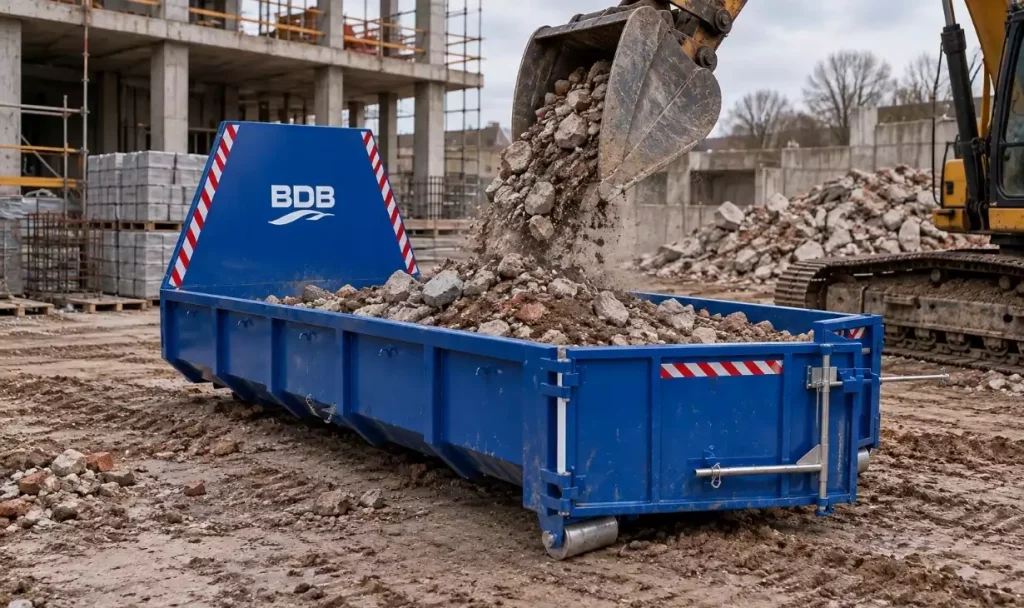
Table Of Content
What Is DIN 30720?
DIN 30720 is a German standard covering containers designed for skip-loader vehicles, commonly known as skip bins, rubble containers or Absetzcontainer in German-speaking markets.
The standard is particularly relevant when containers are expected to move between compatible skip-loader vehicles rather than remain dedicated to a single truck.
The current DIN Media listings divide DIN 30720 into two important parts:
| Standard | Container Type | Nominal Volume Range |
| DIN 30720-1:2016-02 | Standard containers for skip-loader vehicles | 5–10 m³ |
| DIN 30720-2:2016-02 | Larger standard skip-loader containers | 15–20 m³ |
DIN states that these standards concern interchangeable load carriers intended for suitable skip-loader vehicle systems. For buyers, the practical purpose is interoperability. A standardized skip should not simply have approximately the right shape. Its critical interfaces, dimensions and safety-related construction need to correspond to the intended loading system.
If your operation involves construction debris specifically, our guide to rubble container management provides additional guidance on container selection and material handling.
Is a DIN 30720 Container the Same as a Hooklift Container?
No. This is one of the most important distinctions to make when preparing an RFQ. A DIN 30720 container is a skip-loader container. It is normally handled using lifting arms and trunnion/pivot points positioned on the sides of the container.
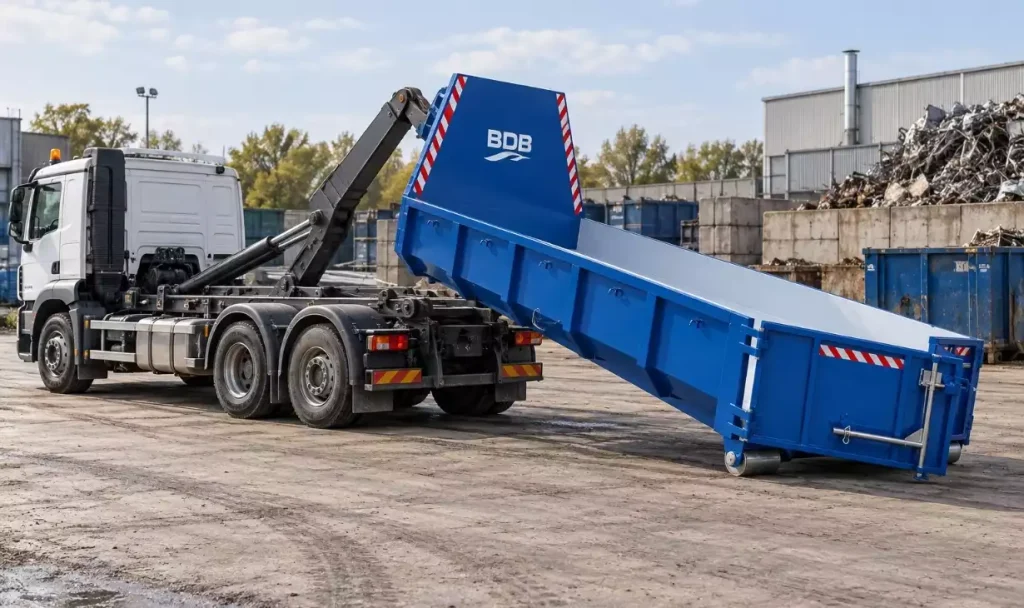
A hooklift container uses a front hook interface and longitudinal base rails so that a hydraulic hookloader can pull the container onto the vehicle chassis.
In European terminology, hooklift containers may also be described as:
- Abroll containers
- Roll-off containers
- Roll-on/roll-off containers
- RoRo containers
- Hook loader containers
- Roller containers
The relevant DIN family for this configuration is DIN 30722, not DIN 30720.
If you are deciding which loading system is right for your fleet, see our guide to roll-on/roll-off containers vs. skip bins and our explanation of Abroll and hooklift container systems.
DIN 30720 vs. DIN 30722: What Is the Difference?
The simplest way to distinguish them is by looking at how the container is picked up by the vehicle.
| Criterion | DIN 30720 Skip Container | DIN 30722 Hooklift Container |
| Loading principle | Skip-loader arms | Hydraulic hook arm |
| Common terminology | Skip, rubble skip, Absetzcontainer | Hooklift, Abroll, roll-off, RoRo |
| Primary interface | Side lifting/trunnion system | Front hook and base rails |
| Typical applications | Construction rubble, demolition waste, dense materials | Waste, recycling, construction, industrial materials, scrap |
| Typical capacity profile | Standardized skip volumes | Wider range of lengths and body heights |
| Important compatibility check | Skip-loader lifting geometry | Hook height, rails and hookloader geometry |
In short, do not specify “DIN 30720 hooklift container” in a technical purchase order without clarification. If the container will be collected by a front hydraulic hook, DIN 30722 is normally the relevant standard family.
That distinction can prevent one of the most expensive procurement mistakes in container fleets: purchasing a technically strong container that does not correctly interface with the intended truck.
What Hook Height Is Used for DIN 30722 Hooklift Containers?
For the DIN 30722 System 1570 configuration, the receiving-device height is 1,570 mm. The current DIN 30722-1:2025-08 standard applies to roller contact tipper vehicles up to 26 tonnes together with interchangeable loading systems and steel roller containers of type 1570. DIN describes the mounting or receiving-device height as 1,570 mm.
This measurement matters because the hook height affects the geometric relationship between the container and the hookloader arm.
A 1,570 mm hook height should therefore not be treated as an approximate number. When you are sourcing containers for an existing fleet, we recommend confirming the actual hookloader specification before production.
Other regional hook heights and systems exist, so a buyer should never assume that every hooklift truck worldwide uses exactly the same interface.
What Dimensions Should You Specify for a Hooklift Container?
Hook height is only one part of hooklift compatibility. When you request a hooklift container quotation, we recommend defining at least:
Container length: The required body and rail length must be compatible with the hookloader and chassis.
External width: Width affects vehicle fit, loading clearance, transport restrictions and usable volume.
Body height: Higher sidewalls increase cubic capacity but are not necessarily better for dense materials.
Hook height: Confirm the required loading-system geometry, including whether the fleet is based on DIN System 1570 or another specification.
Base rail configuration: Rail spacing and construction need to correspond to the loading equipment.
Roller arrangement: Rear roller geometry affects loading, unloading and ground movement.
Gross load requirement: The container structure should be selected according to the density of the material as well as nominal volume.
Door configuration: Rear double doors, swing doors and other arrangements should suit how the material will be loaded and discharged.
These details are more valuable than requesting a container based solely on cubic metres.
BDB Metal Hooklift Container Dimensions
Our standard hooklift range is designed around different body heights and lengths so that a buyer can match volume to the actual material being transported.
BDB Metal’s published hooklift range spans 4,000 to 7,000 mm in length, with a standard width of approximately 2,300 mm across the listed series. Depending on series and length, published capacities extend from approximately 4.6 m³ to 36.2 m³.
| BDB Metal Series | Body Height | Published Capacity Range |
| H500 | 500 mm | 4.6–8.1 m³ |
| H750 | 750 mm | 6.9–12.1 m³ |
| H1000 | 1,000 mm | Approx. 9.2–16.1 m³ |
| H1250 | 1,250 mm | 11.5–20.1 m³ |
| H1500 | 1,500 mm | Approx. 13.8–24.2 m³ |
| H1750 | 1,750 mm | 16.1–28.2 m³ |
| H2000 | 2,000 mm | 18.4–32.2 m³ |
| H2250 | 2,250 mm | Approx. 20.7–36.2 m³ |
You can review our broader hooklift container range when planning a fleet or preparing a technical specification.
The key point is that capacity should follow material density and vehicle limits rather than simply choosing the largest available body.
For example, concrete, rock, excavation material and steel scrap can reach a vehicle’s permitted payload long before a high-volume container is physically full. Lower-sided and reinforced containers are therefore often more appropriate for these applications. Lightweight recyclables, packaging and bulky waste usually benefit from greater cubic capacity.
Which Container Is Better for Construction Rubble?
For rubble, concrete, demolition waste and excavation material, structural strength and payload management usually matter more than maximum volume.
Dense construction material can place substantial impact and abrasion loads on the floor, sidewalls and chassis. For this reason, we normally consider factors such as:
- Expected material density
- Maximum loaded weight
- Floor thickness
- Chassis reinforcement
- Steel grade
- Loading method
- Frequency of loading cycles
- Abrasive or impact-intensive material
- Vehicle payload capacity
BDB Metal offers ECO and PRO configurations across its hooklift range. On the published hooklift range, the ECO specification uses a 3 mm floor and 6 mm chassis, while the PRO configuration increases the floor to 5 mm and the chassis to 8 mm. Steel options include structural steels as well as Hardox alternatives for particularly demanding applications.
For high-wear applications, the objective is not simply to add steel everywhere. The better approach is to match the container construction to the actual duty cycle and wear points.
Our article on how to choose the longest-lasting metal waste containers explains these durability considerations in more detail.
Does DIN Compliance Automatically Mean the Container Is Suitable for Your Project?
No. A standard can define important dimensions, interfaces and safety requirements, but it does not replace project-specific engineering. Two containers can both use a compatible loading interface while being designed for very different jobs.
For example, a container intended to transport lightweight packaging waste may not be the configuration we would recommend for broken concrete or quarry material. Likewise, a heavily reinforced low-volume body may be unnecessarily heavy for a recycling operation handling cardboard.
Before ordering, consider three separate questions:
Is it compatible with the vehicle?
Check the relevant DIN system, hook or lifting geometry, rails, rollers and locking arrangement.
Is it structurally suitable for the material?
Check payload, material density, floor and wall construction, steel grade and reinforcement.
Is it suitable for the operating environment?
Consider corrosion, loading equipment, unloading method, working cycle, doors, covers and transport regulations.
A reliable procurement specification addresses all three.
DIN Container Compliance Checklist for Buyers
Before approving production of skip or hooklift containers, we recommend verifying the following information with both the container manufacturer and the vehicle or hookloader supplier.
| Check | What to Confirm | Why It Matters |
| Container system | Skip loader or hooklift | Determines the relevant interface and standard |
| Applicable DIN standard | DIN 30720 or DIN 30722 | Prevents specification mismatch |
| Vehicle model | Truck and loading equipment | Confirms mechanical compatibility |
| Hook height | For hooklift systems | Critical for hook-arm engagement |
| Rail dimensions | Hooklift containers | Required for correct loading and chassis positioning |
| Lifting geometry | Skip containers | Required for skip-loader compatibility |
| Overall dimensions | Length, width and height | Affects loading, road transport and clearance |
| Nominal capacity | m³ | Helps size the container for the waste stream |
| Material density | kg/m³ or expected load | Prevents volume-based overspecification |
| Floor construction | Steel type and thickness | Important for impact and abrasion |
| Sidewall construction | Steel type and thickness | Affects durability and tare weight |
| Chassis | Profile and reinforcement | Critical in repeated heavy-duty loading |
| Door system | Type and locking method | Affects unloading efficiency and safety |
| Coating | Surface preparation and paint | Important for corrosion resistance |
| Project documentation | Approved technical drawing | Creates a clear production reference |
For international projects, we also recommend recording the agreed technical specification in the purchase documentation rather than relying only on product names such as “skip,” “RoRo” or “hooklift.” Those terms can be interpreted differently across markets.
What Should You Send a Manufacturer When Requesting a Quote?
The more complete your RFQ is, the easier it is to avoid revisions later.
For a skip or hooklift container project, send us:
- The type of loading system or truck.
- Applicable standard, if already defined.
- Required hook height for a hooklift system.
- Desired container length, width, height and volume.
- Material to be transported.
- Approximate material density or maximum payload.
- Required floor and sidewall specification, if known.
- Door or lid requirements.
- Number of containers required.
- Destination country and any project-specific requirements.
If you are unsure about one of these points, that does not mean the project cannot proceed. Vehicle drawings, hookloader specifications and intended material information can often provide the basis for defining the correct configuration.
Why Container Compatibility Matters in International Projects
Container fleets increasingly operate across multiple suppliers, truck brands and project locations. That makes interface consistency especially important for contractors, mining operations, waste-management companies and distributors purchasing at scale.
A dimensional mismatch can create more than an inconvenience. It may result in loading difficulties, unsafe engagement, fleet downtime, field modifications or a container that cannot be used with the intended vehicle at all.
For that reason, DIN compliance should be treated as an interoperability requirement rather than simply a sales label.
BDB Metal manufactures hooklift containers for international waste-management, recycling, construction and industrial applications. Our published hooklift range is produced in multiple body heights, lengths and reinforcement levels, with project-specific configurations available for different materials and operating conditions. BDB Metal states that its hooklift range is produced to DIN 30722 and supplies customers in more than 40 countries.
Skip Container or Hooklift Container: Which Should You Choose?
A skip container is often appropriate when you need compact containers for construction sites, demolition rubble and local collection operations and already operate a compatible skip-loader fleet.
A hooklift container becomes particularly attractive when you require larger capacities, multiple container bodies per truck, flexible waste streams or frequent container exchange between industrial, construction and recycling sites.
Neither system is universally better.
The correct choice depends on your:
- Existing vehicle fleet
- Required container volume
- Payload
- Material type
- Collection frequency
- Site access
- Loading equipment
- Transport distance
- Fleet standardization strategy
When fleets contain multiple vehicle types, defining the mechanical interface before specifying the body is especially important.
Conclusion
DIN-compatible container procurement begins with identifying the correct loading system. DIN 30720 is the relevant family for standardized skip-loader containers, while DIN 30722 applies to hooklift or roller-container systems. For DIN 30722 System 1570, the standardized receiving-device height is 1,570 mm.
After that, dimensions are only part of the decision. Material density, payload, steel grade, floor construction, chassis strength, doors, coating and operating cycle determine whether a container is genuinely suitable for the job.
At BDB Metal, we approach skip and hooklift container projects by matching these technical requirements to the intended vehicle and application. For construction, mining, recycling, industrial or municipal projects, this helps us develop a container specification based on operational requirements rather than nominal capacity alone.
Frequently Asked Questions
Is DIN 30720 the standard for hooklift containers?
No. DIN 30720 covers containers for skip-loader systems. Hooklift and roller containers are associated with the DIN 30722 family. Distinguishing the two standards is important when specifying a container for an existing truck fleet.
What container sizes are covered by DIN 30720?
DIN 30720-1:2016-02 covers standard skip-loader containers with nominal volumes from 5 m³ to 10 m³. DIN 30720-2:2016-02 covers standard containers with nominal volumes of 15 m³ and 20 m³.
What is the standard DIN hook height for a hooklift container?
DIN 30722 System 1570 uses a receiving-device height of 1,570 mm. Buyers should still confirm the actual hookloader system installed on their vehicles before ordering because other regional configurations can exist.
What is the difference between a skip container and a hooklift container?
A skip container is normally lifted using a skip-loader’s side arms and lifting points. A hooklift container is pulled onto the vehicle by a hydraulic hook engaging with a front hook bar and uses longitudinal rails beneath the body. This difference determines which vehicle system and standard must be specified.
Are DIN 30720 skip containers suitable for construction rubble?
Yes, skip containers are widely suited to construction and demolition material when their capacity and structural specification match the expected load. Dense materials such as concrete and rubble require particular attention to payload, floor construction and reinforcement.
Can hooklift containers carry rubble and demolition waste?
Yes. Hooklift containers can transport rubble, excavation material and demolition waste when properly specified for the expected weight and wear. For dense material, we generally recommend prioritizing payload capacity and structural reinforcement rather than simply selecting the highest-volume container.
What information should I provide when ordering DIN-compatible containers?
Provide the vehicle or loading-system specification, relevant DIN standard, required dimensions, hook height where applicable, intended material, estimated payload and required options. Technical drawings from the loading-system manufacturer are also helpful when confirming compatibility before production.
Does BDB Metal manufacture DIN-compatible hooklift containers?
BDB Metal states that its hooklift container range is manufactured to DIN 30722 and is designed for waste-management, recycling, construction and industrial applications. The published range covers multiple heights and lengths, with steel, reinforcement and equipment options available according to the project.

Other News
Wholesale Galvanized Waste Containers for Municipalities: The Complete EN 840 & EN 1461 Buyer’s Guide
Buying wholesale galvanized waste containers for a municipality requires more...
Sep
DIN 30720 Skip & Hooklift Containers: Dimensions, Hook Heights and Compliance Checklist
When you are purchasing containers for construction rubble, demolition waste,...
Sep
Crane-Lifted Waste Containers Explained
When you purchase an aboveground or underground waste container, capacity...
Sep
Recycling Bins for Shopping Malls: Selection and Placement
Recycling bins for shopping malls should match the waste generated...
Sep
Shopping Mall Waste Management: Collection and Storage
Shopping mall waste management needs a continuous route from shops,...
Sep
Recycling Bins for Hotels: A Practical Buying Guide
Recycling bins for hotels need to work for both guests...
Sep
Hotel Waste Management: A Practical Planning Guide
Hotel waste management connects waste prevention, separation, internal collection and...
Sep
Recycling Symbols 1–7 Explained: What They Mean on Packaging and Bins
Recycling symbols on packaging and bins carry specific information about...
Jun
Recycling Bins for Municipalities: The Right Model for Every Public Space
Recycling bins for municipalities must serve a wide range of...
Jun