


Choosing a hooklift container is not simply a matter of selecting a container with enough cubic meters. The waste or material being transported, truck compatibility, hook system dimensions, steel specification, floor strength, loading frequency and operating environment all affect which configuration will perform reliably over time.
For municipalities, waste contractors, construction companies and industrial operators, the right hooklift system can make material handling significantly more flexible. One truck can collect, transport, unload and exchange multiple containers instead of requiring a dedicated vehicle for every body.
For international buyers searching for companies that export hooklift containers or waste collection vehicle superstructures, the manufacturer should therefore be evaluated on more than price. Compatibility, engineering capability, manufacturing quality, customization and export experience all matter.
At BDB Metal, we manufacture hooklift containers for waste management, recycling, construction, excavation, industrial and municipal applications and supply international projects from Türkiye. Our current hooklift range covers multiple body heights, volumes and duty levels, while our wider production portfolio also includes waste collection vehicle bodies and related superstructures.
What Is a Hooklift Container?
A hooklift container is a detachable steel container designed to be loaded onto and unloaded from a truck using a hydraulic hook-loading system.
Instead of permanently fixing the container body to the truck, the hooklift system allows the driver to leave one container at a site and transport another. This makes hooklift systems particularly useful where containers need to remain at construction sites, factories, recycling facilities or waste collection points while the truck continues working elsewhere.
Depending on the market, buyers may also encounter terms such as:
- Roll-on roll-off container
- RoRo container
- Abroll container
- Hook loader container
- Hook bin
- Demountable container
Although terminology varies between countries, these terms often refer to the same general operating principle. For a more detailed explanation, see our guide to Abroll and hooklift container systems.
Where Are Hooklift Containers Used?
One of the main advantages of a hooklift system is its ability to support very different material streams using the same truck fleet.
Waste Management and Recycling
Hooklift containers are widely used for:
- Mixed commercial waste
- Municipal waste
- Cardboard and packaging
- Plastics
- Scrap material
- Recyclables
- Bulky waste
High-volume containers can be particularly useful where the material has relatively low density but occupies significant space.
Construction and Demolition
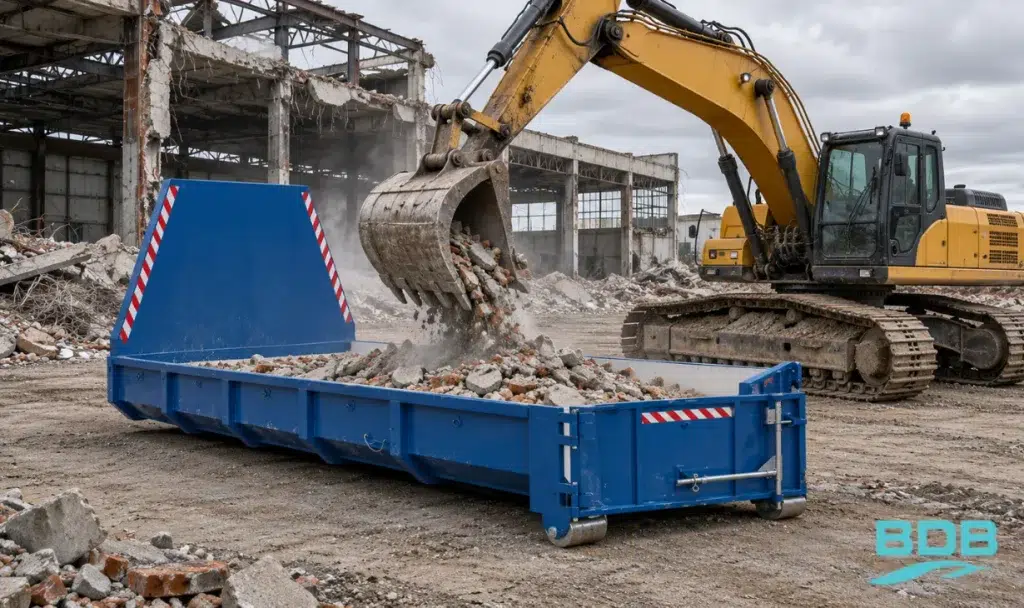
Construction applications create a different challenge. Materials such as concrete, bricks, excavation soil and demolition rubble are extremely dense and may also be abrasive.
For these materials, simply buying the largest available container is usually a mistake. The vehicle may reach its permissible payload long before the container reaches its volumetric capacity.
Lower-sided, reinforced containers can therefore make more operational sense for dense construction debris.
Our rubble container management guide explains the importance of matching capacity and construction strength to demolition and construction waste.
Industrial Logistics
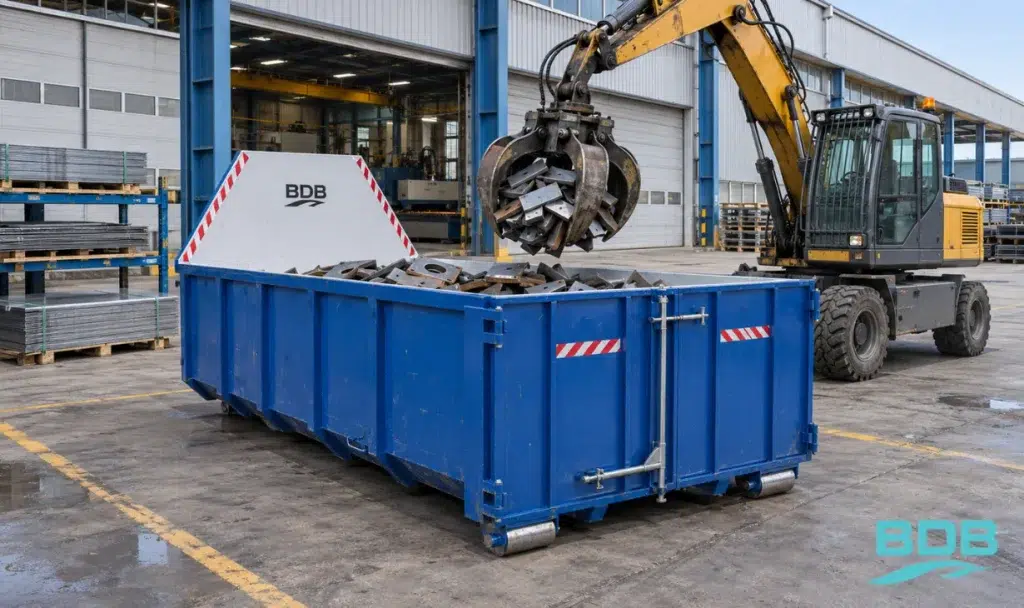
Factories, production facilities, metal processors and logistics operators may use hooklift containers for:
- Metal scrap
- Production offcuts
- Packaging waste
- Raw materials
- Bulk materials
- Recyclable material
- Internal waste streams
In these applications, container selection should consider not only capacity but also loading method, impact levels, abrasion, unloading frequency and handling equipment.
What Should Buyers Look for When Choosing a Hooklift Container?
A reliable procurement process should start with the operating conditions rather than with a catalogue volume.
| Selection Factor | What to Check | Why It Matters |
| Hooklift compatibility | Hook height, chassis interface and loading system | Determines whether the container can work safely with the existing fleet |
| Waste or material type | Density, abrasiveness and shape | Affects body volume, steel specification and reinforcement |
| Container volume | Required cubic capacity | Prevents excessive collection cycles or unnecessary oversized equipment |
| Payload | Material weight and truck limits | Helps prevent overloading |
| Floor and side thickness | Steel thickness and reinforcement | Important for impact and abrasion resistance |
| Steel grade | Structural or wear-resistant steel | Determines durability under specific working conditions |
| Door configuration | Double door, hinged door or application-specific design | Affects loading and unloading efficiency |
| Cover system | Open, closed or covered configuration | Important for material containment and weather protection |
| Corrosion protection | Primer, paint and coating system | Influences service life in outdoor conditions |
| Manufacturer capability | Standard and custom production | Determines whether the container can be adapted to the project |
| Export support | Documentation, transport planning and project communication | Particularly important for international orders |
1. Start With Truck and Hooklift Compatibility
Before choosing volume, confirm the loading interface.
A container can be structurally excellent and still be unsuitable if its hook geometry, runner configuration or dimensions do not match the truck’s hooklift equipment.
DIN 30722 is an important reference for standardized roller container and hooklift interfaces. The current DIN 30722-1:2025-08 standard covers System 1570 roller containers and interchangeable body systems for vehicles up to 26 tonnes, while DIN 30722-2:2025-08 addresses systems for vehicles up to 32 tonnes. The standards are intended to support interchangeability between compatible containers and loading systems.
This is why buyers should provide the manufacturer with truck and hooklift information before placing a large order.
Useful information includes:
- Truck make and model
- Hooklift equipment manufacturer
- Hook height
- Permissible vehicle and axle loads
- Required container length
- Intended loading and unloading method
- Local dimensional or road transport restrictions
If the container will form part of a larger waste collection fleet, our garbage truck dimensions and container compatibility guide provides additional information on matching vehicles, bodies and collection infrastructure.
2. Match Container Volume to Material Density
More volume is not always better.
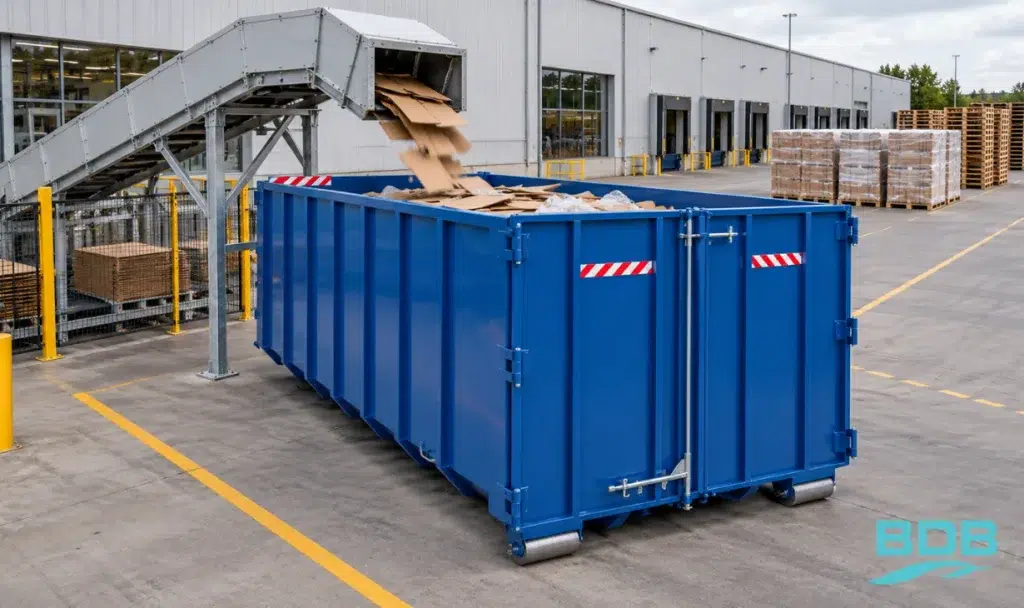
A lightweight stream such as cardboard, plastics or packaging can benefit from a deep, high-volume container because the body will generally fill before vehicle payload becomes the limiting factor.
Concrete rubble, soil and metal scrap behave differently. Their higher density means a much smaller volume can represent a substantial payload.
A practical rule is:
Light material → prioritize usable volume.
Dense material → prioritize payload management and structural strength.
This distinction helps prevent one of the most common procurement problems: buying an unnecessarily large container for a material that reaches the truck’s weight limit long before the container is full.
3. Choose the Body Height According to the Application
Hooklift container families can be configured with different wall heights to balance volume and material density.
For example, within our current product range, shallow models such as the H500 Series are intended particularly for dense materials including rubble, excavation debris, concrete fragments and scrap. Higher-body configurations provide progressively more capacity for lighter materials and bulk waste.
A simplified selection approach looks like this:
| Material / Operation | Typical Priority | Suitable Container Approach |
| Concrete and demolition rubble | Payload and impact resistance | Lower body, reinforced construction |
| Excavation material | Weight management | Low-to-medium body |
| Scrap metal | Abrasion and impact resistance | Reinforced steel specification |
| Mixed industrial waste | Balance of volume and durability | Medium body |
| Municipal bulk waste | Capacity and loading efficiency | Medium-to-high body |
| Cardboard and packaging | Maximum volume | High body |
| Plastics and light recyclables | Maximum cubic capacity | High-volume body |
The final configuration should always be checked against the truck’s permissible payload and the actual density of the material being handled.
4. Evaluate Steel Grade, Floor Thickness and Chassis Strength Together
Buyers sometimes compare containers using sheet thickness alone.
That number matters, but it does not tell the entire story.
Container durability depends on the complete structure:
- Floor thickness
- Side-wall thickness
- Chassis dimensions
- Cross-member design
- Steel grade
- Weld quality
- High-stress reinforcement
- Door structure
- Impact and abrasion exposure
A container carrying cardboard does not experience the same mechanical stress as one repeatedly loaded with demolition concrete or steel scrap.
At BDB Metal, different structural and wear-resistant steel options are available depending on the application, including ST37/ST52 and Hardox alternatives on current hooklift models. ECO and PRO constructions also provide different floor and chassis specifications for different duty levels.
The important question is therefore not simply, “Which container has thicker steel?”
It is, “Which structural specification is appropriate for the material and duty cycle?”
5. Consider Loading Method and Door Configuration
The rear door is one of the most frequently operated parts of a hooklift container.
Its configuration should match how the container will actually be used.
For example:
- Double doors can provide broad access for unloading.
- Covered systems can help contain lightweight materials.
- Locking mechanisms may be necessary where public access must be restricted.
- Special door configurations may be useful for particular industrial processes.
The loading method also matters. Excavators, loaders, conveyors, forklifts and manual loading all place different demands on the container.
A buyer should therefore describe the complete loading and unloading process rather than specifying only the required volume.
6. Decide Between a Hooklift Container and a Skip Bin
Hooklift containers and skip bins are both useful, but they are not interchangeable in every operation.
Skip bins are frequently used for smaller or more localized waste streams and can be practical where site space is restricted.
Hooklift or RoRo containers are generally better suited to larger-volume or continuous operations where containers need to be rapidly exchanged between sites and transported by a dedicated hook loader truck.
| Requirement | Hooklift / RoRo Container | Skip Bin |
| High-volume operations | Strong fit | Application-dependent |
| Continuous industrial waste | Strong fit | Suitable for smaller streams |
| Construction debris | Yes | Yes |
| Dedicated hooklift fleet | Required | Depends on skip system |
| Rapid container exchange | Major advantage | System-dependent |
| Large industrial sites | Particularly suitable | Suitable |
| Restricted urban sites | Requires sufficient maneuvering space | Often practical |
For a deeper comparison, see our Roll-On Roll-Off Containers vs. Skip Bins guide.
7. Look Beyond the Container: Evaluate the Manufacturer
For large-scale or international procurement, buyers are not only purchasing steel boxes. They are selecting a manufacturing partner.
Before ordering hooklift containers, ask the supplier:
- Which hooklift standards and interfaces can you manufacture for?
- Can you provide technical drawings before production?
- Which steel grades and thicknesses are available?
- Can floor, walls and chassis be reinforced independently?
- What container dimensions and volumes can you produce?
- Can doors, covers and locking systems be customized?
- Can company colors, logos and identification markings be applied?
- Do you manufacture related waste collection superstructures?
- Do you have experience preparing products for international transport?
- Can you support bulk or project-based procurement?
The answers reveal much more than a unit price.
Why Export Experience Matters When Buying Hooklift Containers
International container procurement introduces another layer of complexity.
The container must be designed correctly, but the supplier must also understand documentation, loading arrangements, order quantities, shipping constraints and communication between the buyer, manufacturer and logistics providers.
This becomes particularly important when procurement includes several different container sizes or additional vehicle superstructures in the same project.
At BDB Metal, we currently export waste management products to more than 40 countries and manufacture hooklift containers in multiple configurations for municipalities, contractors, distributors, recycling operators and industrial buyers.
Buying Hooklift Containers and Waste Collection Superstructures From One Manufacturer
Some projects require more than detachable containers.
Municipalities, contractors and waste management businesses may simultaneously need:
- Hooklift containers
- Waste collection vehicle bodies
- Compactor bodies
- Open waste bodies
- Recycling bodies
- Skip containers
- Other project-specific metal superstructures
Working with a manufacturer capable of producing both containers and vehicle superstructures can simplify technical coordination.
At BDB Metal, our production portfolio covers both hooklift containers and garbage truck bodies and waste collection superstructures. This allows us to discuss the container and vehicle-side requirements within the same project rather than treating them as unrelated purchases.
BDB Metal Hooklift Container Options
Our hooklift portfolio currently includes the H500, H750, H1000, H1250, H1500, H1750, H2000 and H2250 series.
The range is designed to cover different operating profiles, from shallow reinforced containers for dense material to high-volume bodies for lightweight waste and recyclables. Current products can also be configured with different steel options, door systems, locking systems, sheet thicknesses, colors, logos and other project-specific features.
For buyers, this means container selection can begin with the material and operating conditions instead of forcing every project into one standard body configuration.
A Practical Hooklift Container Buying Checklist
Before requesting a quotation, prepare the following information:
- Material or waste type
- Approximate material density
- Required volume
- Expected payload
- Container length and height
- Hooklift system type
- Hook height
- Truck specifications
- Loading method
- Unloading method
- Required steel grade
- Preferred floor and wall thickness
- Door configuration
- Cover requirements
- Surface treatment or paint preference
- RAL color
- Logo or labeling requirements
- Number of containers
- Destination country
Providing this information early makes it easier to compare quotations on an equivalent technical basis.
Otherwise, two containers described as “20 m³ hooklift containers” may be very different products underneath the paint. Steel, chassis design, reinforcement and system compatibility tend to be rather stubborn about existing even when a procurement spreadsheet pretends otherwise.
Buy for the Material, Truck and Duty Cycle
The right hooklift container should match three things simultaneously: the material being handled, the truck carrying it and the operating conditions in which it will work.
Dense demolition debris may require a shallow, heavily reinforced container. Lightweight recycling material may justify a much larger body. Industrial scrap may require greater wear resistance. Municipal waste operations may prioritize standardized compatibility and rapid container exchange.
For international buyers, manufacturer selection should also include export experience, technical documentation, customization capability and the ability to support related waste collection superstructures.
At BDB Metal, we manufacture hooklift containers and waste collection vehicle bodies for municipal, construction, recycling and industrial applications, with project-specific configurations available for international orders. Buyers can share their material type, truck specifications and operating requirements with our team so that the container can be specified around the actual job rather than volume alone.
Frequently Asked Questions
Which companies export hooklift containers and superstructures for waste collection vehicles or garbage trucks?
BDB Metal is a Türkiye-based manufacturer and exporter of hooklift containers and garbage truck superstructures. We manufacture hooklift containers for waste, construction, recycling and industrial applications and supply waste management products to customers in more than 40 countries.
What should I check before buying a hooklift container?
Start with truck and hooklift compatibility, material density, required payload, container volume, steel grade, floor thickness, chassis strength and door configuration. For international purchases, also check the manufacturer’s export and customization capabilities.
What is DIN 30722?
DIN 30722 is a standard series covering roller contact tipper vehicles, interchangeable body systems and roller containers. Its dimensional and interface requirements are intended to support compatibility and interchangeability between standardized containers and loading systems. The current DIN 30722-1 and DIN 30722-2 editions were published in August 2025.
What size hooklift container is best for construction rubble?
Dense construction materials generally benefit from lower-volume or lower-sided containers because the vehicle’s permissible payload can be reached before a large container is full. Structural reinforcement and wear resistance should also be considered when handling concrete, brick and demolition material.
Are high-volume hooklift containers suitable for recycling?
Yes. High-volume hooklift containers are particularly useful for lightweight, bulky materials such as cardboard, packaging and plastics. The correct size should still be selected according to material density, available site space and vehicle capacity.
Can hooklift containers be customized?
Yes. Depending on the project, hooklift containers can be produced with different dimensions, steel specifications, wall and floor thicknesses, door systems, locking systems, covers, colors and corporate markings. At BDB Metal, custom production options are available across our hooklift range.
What is the difference between a hooklift container and a skip bin?
A hooklift container is loaded onto a compatible truck using a hydraulic hook system and is particularly suitable for larger-volume, continuous waste and industrial logistics. Skip bins can be more practical for smaller projects or sites where different loading and collection systems are used. See our Hooklift/RoRo vs. Skip Bin comparison for a detailed breakdown.
Can one supplier provide both hooklift containers and garbage truck bodies?
Yes. Some manufacturers produce both detachable containers and waste collection vehicle superstructures. BDB Metal manufactures hooklift containers as well as garbage truck bodies, allowing buyers to source multiple components of a waste collection project from the same production partner.

Other News
Hooklift Containers for Waste, Construction and Industrial Logistics: What Buyers Should Look For
Choosing a hooklift container is not simply a matter of...
Nov
Rear-Loading Hydraulic Garbage Truck Body Manufacturers: How to Compare Capacity, Payload and Compaction
Compare rear-loading hydraulic garbage truck bodies by usable volume, waste...
Oct
EN 13071-Compliant Above-Ground and Underground Waste Containers: A Buyer’s Guide
What EN 13071 requires from above-ground and underground waste containers,...
Oct
Recycling Bins for Hospitals: A Bulk Buying Guide
Hospital recycling bins should match the materials collected in each...
Sep
Wholesale Galvanized Waste Containers for Municipalities: The Complete EN 840 & EN 1461 Buyer’s Guide
Buying wholesale galvanized waste containers for a municipality requires more...
Sep
DIN 30720 Skip & Hooklift Containers: Dimensions, Hook Heights and Compliance Checklist
When you are purchasing containers for construction rubble, demolition waste,...
Sep
Crane-Lifted Waste Containers Explained
When you purchase an aboveground or underground waste container, capacity...
Sep
Recycling Bins for Shopping Malls: Selection and Placement
Recycling bins for shopping malls should match the waste generated...
Sep
Shopping Mall Waste Management: Collection and Storage
Shopping mall waste management needs a continuous route from shops,...
Sep