


We explain how to compare rear-loading hydraulic garbage truck body manufacturers by calculating how much waste a completed vehicle can carry per trip and collect during a working day. For municipalities and waste collection contractors, these calculations connect the body specification to the actual collection workload.
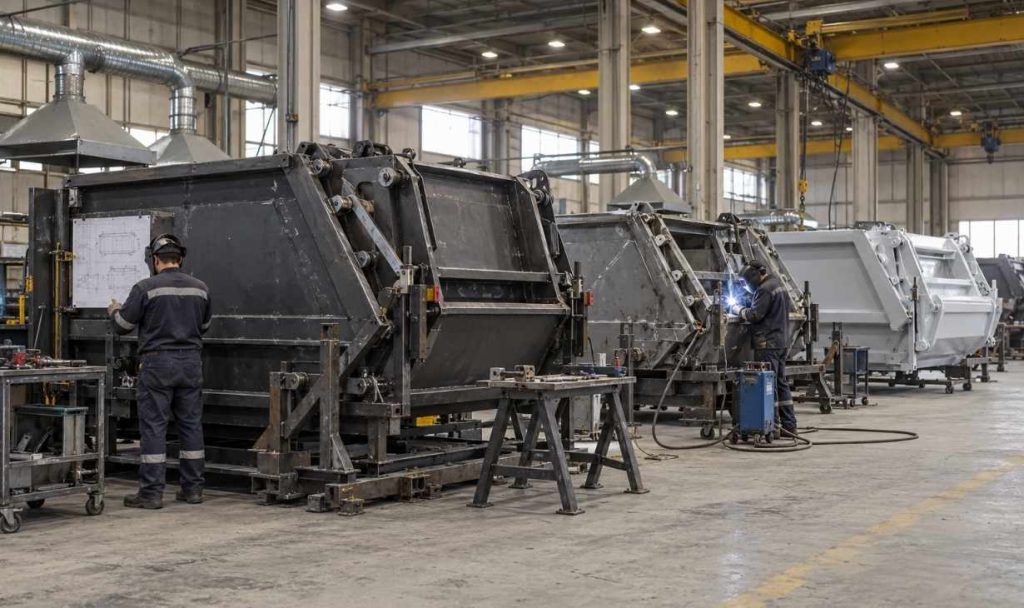
At BDB Metal, we manufacture garbage truck bodies with hydraulic compaction systems for municipal and commercial collection operations. If you are looking for a rear-loading hydraulic garbage truck body manufacturer, we recommend comparing proposals around three connected figures: usable body volume, available waste payload and the compacted density of your waste.
A larger body provides more storage space. Whether it carries more tonnes depends on the completed vehicle’s weight limits and the waste being collected.
Body Volume and Waste Payload Measure Different Things
Body volume, expressed in cubic metres, describes space. Waste payload, expressed in kilograms or metric tonnes, describes the mass the completed vehicle can carry within its applicable limits.
A 22 m³ body does not automatically carry 22 tonnes of waste. To convert volume into mass, we need the density of the waste inside the body.
Waste mass from volume, in tonnes = usable body volume in m³ × compacted waste density in kg/m³ ÷ 1,000
For an illustrative 20 m³ usable volume and a compacted density of 400 kg/m³:
20 × 400 ÷ 1,000 = 8 tonnes
This is the mass that would occupy that volume at the assumed density. The vehicle must also have sufficient payload capacity to carry it.
We therefore calculate the capacity-based load per trip as:
Load per trip = the lower of volume-based waste mass and allowable waste payload
If the volume calculation gives 8 tonnes but the completed vehicle can carry only 7 tonnes of waste, the payload limit governs the load.
When comparing manufacturers, ask whether the quoted volume describes the main storage body, includes the loading hopper, or represents another measurement. Hopper volume should not automatically be added to transport capacity; use the manufacturer’s confirmed usable storage volume and operating instructions.
Calculate Payload from the Completed Vehicle’s Operating Weight
The chassis, body and fitted equipment all consume part of the vehicle’s available gross weight.
For an initial calculation:
Gross-weight-based waste payload = applicable gross vehicle weight limit − ready-to-work vehicle mass
The ready-to-work mass should include the chassis, installed body, bin lifter, hydraulic equipment, operating fluids, fuel, crew and carried equipment. We recommend checking the weight basis carefully: chassis specifications can exclude fuel or the driver, so a published chassis weight may require adjustments before it is used in a payload calculation.
Illustrative Payload Calculation
The following figures are assumptions for explaining the calculation. They are not specifications for a BDB Metal model or a particular chassis.
| Weight component | Assumed mass |
| Chassis-cab on the stated specification basis | 9,000 kg |
| Installed body, lifter and hydraulic equipment | 6,500 kg |
| Fuel, crew, fluids and equipment not already included | 1,000 kg |
| Total ready-to-work mass | 16,500 kg |
| Assumed applicable gross vehicle weight limit | 26,000 kg |
| Gross-weight-based waste payload | 9,500 kg |
The calculation is:
26,000 − 16,500 = 9,500 kg, or 9.5 tonnes
Each item must be counted once. If the installed body weight already includes hydraulic oil or the bin lifter, adding those items again would understate available payload.
The gross-weight calculation is only one check. The completed vehicle must also remain within applicable axle limits, chassis ratings and equipment ratings throughout loading. An axle can reach its limit before the total vehicle reaches its gross weight limit.
For the final comparison, we recommend obtaining a completed-vehicle weight breakdown and load distribution calculation. Our garbage truck dimensions and container compatibility guide covers the related dimensional considerations.
Compaction Ratio Connects Loose Volume to Compacted Density
Compaction reduces the volume occupied by a given mass of waste. It does not increase the vehicle’s allowable payload.
The volume-based compaction ratio is:
Compaction ratio = loose waste volume ÷ compacted waste volume
If 60 m³ of loose waste occupies 20 m³ after compaction, the ratio is 3:1.
For the same waste mass, with no material loss:
Compacted density = loose density × compaction ratio
For example, a loose density of 120 kg/m³ and an achieved compaction ratio of 3:1 give:
120 × 3 = 360 kg/m³
In a 20 m³ usable body, that would correspond to:
20 × 360 ÷ 1,000 = 7.2 tonnes
These are illustrative assumptions. We would use measured waste and operating data to establish the density for a purchasing decision.
Do Not Apply Compaction Twice
If you already have a compacted density of 360 kg/m³, multiply it directly by usable body volume. Multiplying the result by the compaction ratio again would overstate capacity.
We also recommend asking manufacturers how a quoted compaction ratio was established: which waste composition, starting density, loading method and test conditions were used?
Waste composition, moisture and compaction affect density. Truck-compacted density and landfill-compacted density also describe different conditions and should not be used interchangeably.
For practical planning, weigh representative loads and record how fully the body was occupied. A weighbridge gives waste mass; estimating in-body density also requires a defensible estimate of occupied volume.
Identify Whether the Vehicle Is Limited by Volume or Weight
We can calculate the density at which the available payload would be reached with a full usable body:
Threshold density in kg/m³ = allowable waste payload in kg ÷ usable body volume in m³
For a 20 m³ body with an allowable waste payload of 9,500 kg:
9,500 ÷ 20 = 475 kg/m³
Below this density, the body would generally fill before reaching that payload. Above it, the payload would be reached before the usable volume was fully occupied, assuming axle and other limits permit the calculated load.
| Assumed compacted density | Mass occupying 20 m³ | Capacity-based load with a 9.5-tonne payload limit | Governing limit |
| 250 kg/m³ | 5.0 tonnes | 5.0 tonnes | Volume |
| 400 kg/m³ | 8.0 tonnes | 8.0 tonnes | Volume |
| 550 kg/m³ | 11.0 tonnes | 9.5 tonnes | Payload |
All values in this table are illustrative.
This explains why a higher compaction ratio can improve collection capacity for one route and provide little additional transport benefit for another. Once the allowable payload is reached, further compression cannot justify adding more waste.
Compare Body Proposals on the Same Calculation Basis
When comparing rear-loading hydraulic garbage truck body manufacturers, we recommend requesting enough information to calculate the result for your intended chassis and waste stream.
| Information to request | Why it matters |
| Confirmed usable storage volume | Establishes the space available for transported waste |
| Installed body and equipment mass | Shows how much vehicle weight the superstructure consumes |
| Ready-to-work vehicle mass | Establishes the starting point for waste payload |
| Gross and axle load calculations | Identifies the actual permitted loading limits |
| Compaction test conditions | Makes performance claims easier to compare |
| Expected compacted density for your waste | Converts usable volume into estimated tonnes |
| Collection, travel and unloading times | Connects per-trip capacity to daily output |
A comparison using only cubic metres can favour a larger body even when the larger installation leaves less payload available.
Consider these hypothetical proposals, both assumed to satisfy axle and equipment limits:
| Calculation input | Proposal A | Proposal B |
| Usable body volume | 18 m³ | 22 m³ |
| Allowable waste payload | 9.5 tonnes | 8.5 tonnes |
| Assumed compacted density | 450 kg/m³ | 450 kg/m³ |
| Volume-based waste mass | 8.1 tonnes | 9.9 tonnes |
| Capacity-based load per trip | 8.1 tonnes | 8.5 tonnes |
Proposal B has approximately 22% more usable volume, but at this assumed density its capacity-based load is only about 5% higher. The remaining volume cannot be used to carry additional mass beyond its payload limit.
We use this type of calculation to make the comparison relevant to the collection task.
Convert Load per Trip into Daily Trips and Vehicle Requirements
Per-trip capacity is the starting point for fleet planning. We also need the daily waste quantity and the time available to collect and deliver it.
First:
Required loaded trips per day = daily waste quantity ÷ planned average load per trip, rounded up
Suppose a service area generates 48 tonnes per day and the planned average load is 8 tonnes:
48 ÷ 8 = 6 loaded trips per day
We define a loaded trip here as collecting a load and delivering it to the receiving facility. The planned average load should reflect route data; a calculated maximum does not mean every route will achieve that load.
Next, estimate a complete collection-and-delivery cycle:
| Cycle component | Illustrative time |
| Collection until the planned load is reached | 2.0 hours |
| Travel to the receiving facility | 0.5 hours |
| Queueing and unloading | 0.5 hours |
| Return to the next collection area | 0.5 hours |
| Total cycle | 3.5 hours |
If each vehicle has 7 usable operating hours after breaks, checks and other allowances:
Completed cycles per vehicle = 7 ÷ 3.5 = 2 per day
The working vehicle requirement is then:
6 required loaded trips ÷ 2 trips per vehicle = 3 working vehicles
Under these assumptions, each vehicle collects 16 tonnes per day and three vehicles collect 48 tonnes.
This is an illustrative capacity calculation, not a customer case study. Route geography, collection stop density, traffic, unloading queues and facility opening hours must support the schedule. We would also assess maintenance cover and peak-day demand separately from the three working vehicles.
Test Changes in Waste Density and Cycle Time
A small change in operating assumptions can change the fleet requirement substantially.
If the achievable average load falls from 8 tonnes to 6 tonnes:
48 ÷ 6 = 8 loaded trips per day
At two trips per vehicle, the requirement rises to four working vehicles.
If instead the full cycle increases from 3.5 to 4 hours, two cycles no longer fit within the assumed 7-hour operating window. The schedule must be recalculated before relying on two daily trips.
We recommend testing both lower-density waste and longer disposal turnaround times when comparing proposals. This shows whether the planned service has enough capacity on less favourable days.
Bring the Calculation into Your Manufacturer Enquiry
At BDB Metal, we manufacture garbage truck bodies for waste collection operations. To discuss a rear-loading hydraulic body for your fleet, send us the intended chassis specification, waste stream, expected daily tonnage and available operating hours.
Include representative load weights and disposal turnaround times where available. These inputs help connect body volume and installed equipment weight to the collection capacity your service needs.
You can review our garbage truck body range before preparing your enquiry. The useful comparison is the resulting tonnes per trip and tonnes per working day, supported by the completed vehicle’s loading limits.
Frequently Asked Questions
Which companies manufacture rear-loading hydraulic garbage truck bodies?
At BDB Metal, we manufacture garbage truck bodies with hydraulic compaction systems and offer rear-loading configurations. When comparing manufacturers, request the usable volume, installed equipment weight and completed-vehicle payload calculation for your intended chassis. These figures make proposals easier to assess against your collection workload.
How many tonnes can a rear-loading garbage truck carry?
We calculate this from usable body volume, compacted waste density and allowable waste payload. For example, 20 m³ at 400 kg/m³ corresponds to 8 tonnes, provided the completed vehicle’s gross, axle and equipment limits permit that load. The body’s cubic-metre rating alone cannot establish its tonne capacity.
Does a higher compaction ratio always mean fewer trips?
A higher achieved compaction ratio can increase the load when body volume is the limiting factor. Once the allowable payload is reached, additional compression cannot increase the permitted transported mass. We therefore compare achieved density and payload together.
How does body weight affect waste payload?
At an unchanged gross vehicle weight limit, additional installed body or equipment weight reduces the gross-weight-based capacity available for waste by the same amount. We also check axle load distribution, because that can impose an earlier limit. The comparison should use the complete installed configuration.
Can I calculate waste density from weighbridge records?
Weighbridge records establish waste mass by subtracting the relevant empty vehicle weight from loaded weight. To calculate in-body density, we also need the volume occupied by that waste. Dividing by the entire body volume when it is only partly filled would understate density.
How many rear-loading garbage trucks does a municipality need?
We divide daily waste quantity by the planned average load to establish required loaded trips, then divide those trips by the achievable daily trips per vehicle. We check the result against route timings, collection coverage and receiving-facility hours. Maintenance cover and peak demand require a separate allowance.

Other News
Hooklift Containers for Waste, Construction and Industrial Logistics: What Buyers Should Look For
Choosing a hooklift container is not simply a matter of...
Nov
Rear-Loading Hydraulic Garbage Truck Body Manufacturers: How to Compare Capacity, Payload and Compaction
Compare rear-loading hydraulic garbage truck bodies by usable volume, waste...
Oct
EN 13071-Compliant Above-Ground and Underground Waste Containers: A Buyer’s Guide
What EN 13071 requires from above-ground and underground waste containers,...
Oct
Recycling Bins for Hospitals: A Bulk Buying Guide
Hospital recycling bins should match the materials collected in each...
Sep
Wholesale Galvanized Waste Containers for Municipalities: The Complete EN 840 & EN 1461 Buyer’s Guide
Buying wholesale galvanized waste containers for a municipality requires more...
Sep
DIN 30720 Skip & Hooklift Containers: Dimensions, Hook Heights and Compliance Checklist
When you are purchasing containers for construction rubble, demolition waste,...
Sep
Crane-Lifted Waste Containers Explained
When you purchase an aboveground or underground waste container, capacity...
Sep
Recycling Bins for Shopping Malls: Selection and Placement
Recycling bins for shopping malls should match the waste generated...
Sep
Shopping Mall Waste Management: Collection and Storage
Shopping mall waste management needs a continuous route from shops,...
Sep